

S2E2: Managing Stress and Influence Without Authority with Keith Allen Johns
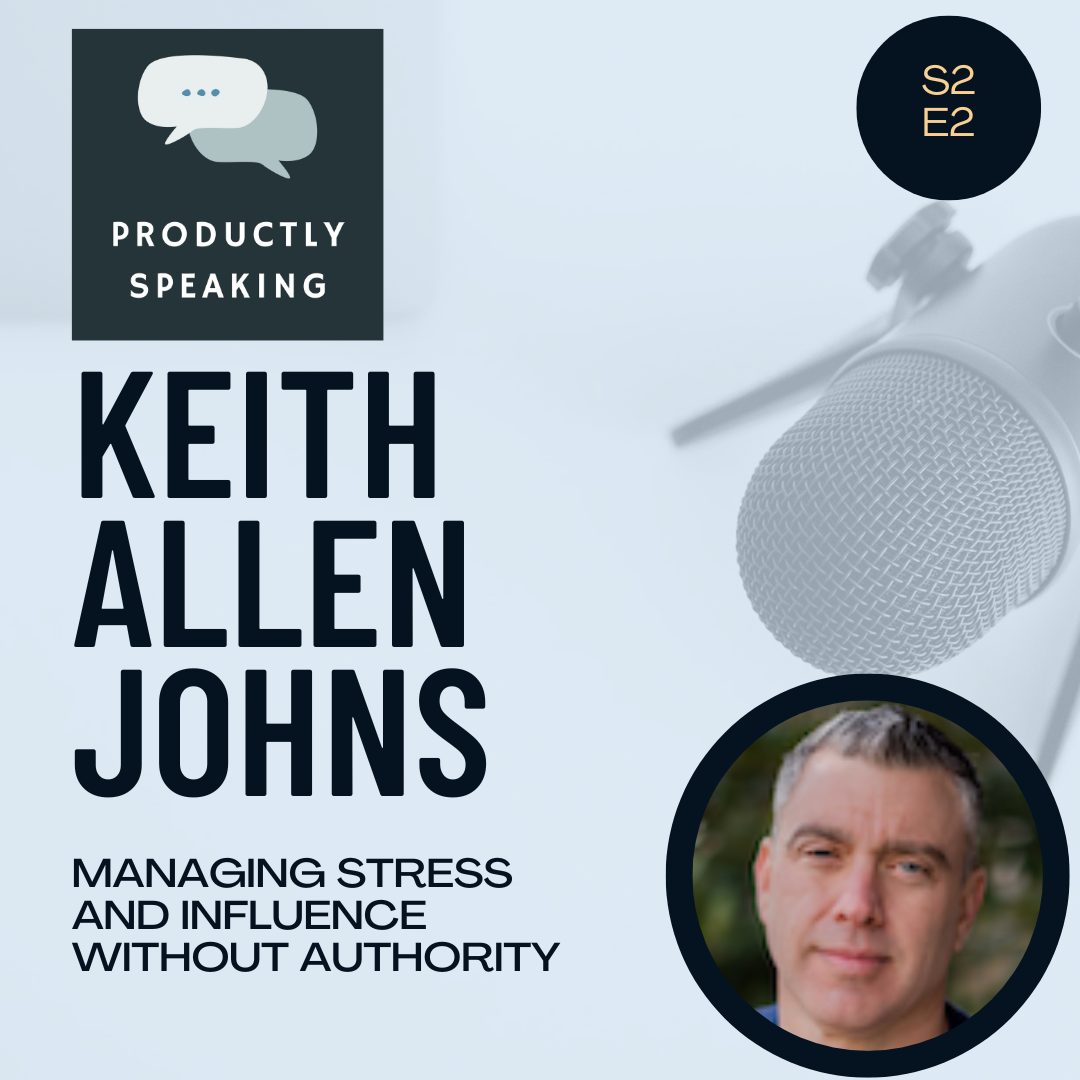


Episode Summary: In this episode of Productly Speaking, Karl sits down with Keith Allen Johns, a seasoned career, business, and life coach. Keith shares his journey from climbing the corporate ladder to the C-suite and eventually transitioning to coaching. The conversation delves into the challenges of product management, focusing on handling stress and influencing without authority. Keith offers valuable insights and practical tools for becoming more self-aware, managing stress, and effectively influencing others.
Key Topics Discussed:
- Challenges in Product Management
- Handling Stress
- Influencing Without Authority
- Keith’s Coaching Approach
- Keith’s Personal Insights
Memorable Quotes from Keith Allen Johns:
- "The change you want to see in your life can all be driven from the inside out."
- "How you choose to handle stress is a choice."
- "Influence begins with understanding the motivations and drives of the people you work with."
Call to Action: Listeners are encouraged to connect with Keith Allen Johns on LinkedIn or visit his website at www.keithallenjohns.com to learn more about his coaching programs and upcoming events.
On today's episode, we're going to talk about handling the stress of product management through
becoming more self-aware and improving our abilities to influence people without authority.
We will look at several mechanisms to help us with that, including storytelling. And to do that,
I'll be talking with Keith Allen Johns, a career, business, and life coach who started by climbing
the corporate ladder all the way to the C-suite and then wondering what was still missing in life.
His journey to figure this out has led him to want to help others to become more present,
engaged, and successful in everything they do. Welcome to Productly Speaking, Keith.
It's good to see you today, buddy. I'm excited for this conversation.
Likewise. You and I have talked a little bit before, and one thing that's really key,
especially in my mind and in the mind of a lot of listeners here, product management can be a
stressful career. It can be. It is. It just is. There's no can be about it. You have stakeholders
to manage. They all want something different. Their needs change. They don't necessarily all
agree with each other on what they want. You have changing requirements, changing markets,
missed deadlines. I mean, I'm almost getting anxiety just talking about all the different
things that we have to deal with here.
Squetty palms engaged.
Yes, exactly. All of this together, it can often feel like the type of role where you struggle to make
meaningful progress. You know, you get up, you do things, you go through the day, you work through the
day, you get to the end of the day, you know you were busy all day. But what did you really
do? And that type of feeling can have a negative impact on those who practice product management.
So what would your advice be to those in this position?
Yeah, it's funny. So my background's in tech. So I've got a soft spot for all the roles in the
tech space because I've seen them all. I've done so many of them. I've tried to help people,
my direct reports at that time in those areas. And it's funny, when I got the idea to start a
coaching business, I needed my first hypothesis. And I was flipping through Harvard Business Review
or Inc or something. And the headline jumped out at me. It said, product management, one of the
toughest jobs, if not the toughest job in tech. And it talked about all that responsibility and
lacking authority. And I thought, all right, well, thank you, universe. I'm going to start reaching
out to product managers across the country and take their temperature and see if they agree and see
if they'd like some help on how to manage things. And that is how my business kind of took off like
hotcakes. In fact, that first year was so successful, I assumed it would just stay that
way forever, right? And then markets change and things change. It was during COVID. But I loved
serving product managers and I loved getting them together to help process issues and challenges.
And so there's really two parts to your question. And one of them is about understanding your progress,
which I think is a little bit different, you know, having meaningful achievement. There's some
tactical, practical things there to setting the table and establishing expectations. But the underlying
foundation of all that is your ability to handle that uncertainty and accept it as part of the job.
Instead of seeking to be stress-free or seeking certainty, which in this world today,
no stress, certainty, it's crazy, right? In fact, what we often do is we seek to calm our systems down
and achieve that state of well-being through unhealthy pursuits. You know, we Netflix and binge,
we overeat, we do all these things to calm our systems down just so we can feel good. Here's the secret.
You're just missing the right tools. And that's where I usually step in with clients.
Well, the problem is this operating system, this bit of technology hasn't been upgraded in 200, 300,000 years.
So as far as our bodies are concerned, we're still on alert from saber-toothed tigers and from being kicked
out of the village, right? All these instincts inside us don't serve us in 2024, but they still pop up and fly up,
right? So we think miscommunication at work is an existential crisis. And our existential crisis
system, our fight-flight kicks in. And we've got all these things that we worry about, but so much of it
is made up, okay? So much of it is an overstretch of reality because our panic button is, it's huge,
it's red, and bam, our brain just hits it. Even when it doesn't need to, it doesn't have a lot
of nuance or subtlety. So what becomes really crucial, you mentioned it, is what I call operational
space. It's starting to separate a higher version of you, an observational version of you. I always,
I put my hand up here and I say, imagine, imagine super you is up here watching you and noticing
and observing. And that's where the transformation starts, where you can start to put things into
perspective. Is this really something that should be keeping me up at night? Or am I going to be okay?
And how you choose to handle stress is a choice. So many people are running their lives, allowing their
lives to be run for them on autopilot. And what I do, I've done deep study of physiology, psychology,
sociology, because I wanted to understand me. I wasn't happy. I didn't handle things well.
And it drove me bananas. So I figured out, with a lot of help, how to handle living in this modern age.
And I realized other people struggle too. And so the tools I developed for myself,
I started to teach them. And it's funny, I didn't know if it was going to work. And then I started to
see the data. And between about four to six weeks of working with me, every single time a client would
say, I'm starting to feel a little different. In fact, one time I was working with a serial
entrepreneur. He's actually in the gas and oil space out of Miami. And he was a real stubborn guy.
Week two, Keith, I'm not feeling anything. I'm a little stressed. I'm like, oh, this guy really wants
to feel the transformation. Week five, week six. Week seven, I get a message from him.
Keith, he's got this accent. He's from Louisiana. Keith, I ain't going to tell you, you changed my
life. But I think you're changing my life. Because give me about five or six weeks,
because we are all wired the same way. And I will help you handle things more effectively.
And that is when the cool stuff really starts to happen.
So what are some of the things that you coach people through to better handle these stresses
that come with the job?
There's very common challenges people bring to me. I'll tell you a story, which is part of
one of the things we're going to talk about today and the way these stories work. So I'm working with
a product manager out of the Midwest. And he came to me and he said, Keith, I feel like there's
something missing. I need some help. I don't have a great relationship with my boss. I'm having a
little bit of lack of alignment with a coworker who is important to me. And I don't know if this
matters as well. But at home, I get frustrated. I get frustrated by my family members. And I said,
great. Would you like all of that to change within four to six weeks? Right? Absolutely. I'm all in.
The first step is this huge epiphany that I had, which is stop worrying about changing the people
around you or expecting them to change. The change you want to see in your life can all be driven from
the inside out. And that is an eye opener for people because we're so used to pointing and blaming,
pointing and blaming, pointing and blaming. If my wife would just cooperate, I could be happy. If my boss
would just cooperate, I could be happy. And it doesn't work. Right? But when we decide to work on
ourselves and generate change from the inside out, things around us magically start to transform.
So this is another person who, this was probably three or four weeks in, he said, Keith,
everyone around me has completely changed. I laughed and I said, oh yeah, tell me about it.
I'm not as frustrated by my wife. My boss is making time for me. And you know what? Here's the craziest
thing. I'm getting along with my stepdaughter. We're having better conversations. There's a whole
series of tools that went into that outcome. And one of them really has to do with perspective
taking. See, we're so aligned internally and inward facing with our thoughts and our feelings and our
emotions. It's so much to process. We have a hard time pushing out and imagining the other person's
role, what they want and what they're trying to achieve. So the shorthand of this, it goes a little
bit like this. So let's say this client is frustrated because he works from home and his wife interrupts
him when he's working from home. He says, I don't like it because I don't like how I respond. Now this
sounds like a very simple, almost cute little story. I'm here to tell you when you work on little
instances like this in your life. This can be with the boardroom. This can be with the C-suite. This can be
at home. Trust me, I've transferred these skills across all areas of my life and my clients have too. I'm
frustrated when I get interrupted. Okay, well, let's talk about what frustration means. Hang on, wait, wait,
don't I just need to tell my wife to stop interrupting me? No. The way you respond to people's behavior around
you is absolutely in your control. And if you want to lower your stress level, if you want to be more in
control of how you feel so you can perform more highly, process what happens in your brain and
outside of you more effectively. I said, you are frustrated. Frustration means you're not getting
what you want. What do you want so badly that you're getting angry at your wife? Well, and here
comes the truth. This is what, well, uh, well, what are you scared of? Ooh, what are you scared of? Well,
if you're frustrated, that's fear based, what are you scared of? And then they start to squirm a little
bit. I'm afraid I'm not going to get my work done. So you're not frustrated with your wife.
You have a fear inside you that when she interrupts you, you're not gonna get your work done.
Is that a realistic fear? Oh, now we've shined the light of the heavens on his baloney, right?
Yeah. Is that realistic? Well, no. Okay. So you have an unfounded fear back to where we started
this conversation. You have an instinct inside you that says, I have to absolutely crush work
24, seven, three 65, because if I don't, I will get fired. I won't be able to provide for my family.
We won't have food. We won't have shelter. We won't have warmth. You start thinking like a caveman
and none of it makes any sense, but it feels-
That just sounds like a day in product management.
Exactly. It feels very real. It feels very, very real. Think about it. If anyone on this call has
lost a job or gone through financial hardship, I don't think I'm talking to a lot of homeless people
today. And there are certainly people that struggle. But if you're listening to this podcast
and you get fired today, odds are you would figure it out. So when you recognize these fears
and they're unfounded, what if you rewired them in the moment? So now we do something I call
guardian at the gate and circuit breaker. So guardian at the gate is when you have a non-serving
thought, we assume they must be true. We assume we must act on them and believe them. And it's baloney.
Our brain's just an organ. It fires useless thoughts at us all day long. To this client,
it was firing a thought that said, holy cow, we're in trouble. We're not going to get our work done.
And he believed it. He believed it. What if you didn't? What if you had a guy or a girl in plate
mail, nerdy fantasy stuff, right? In plate mail with a big spear, 10 feet tall. And he does the
Lord of the Rings things. You shall not pass. And you question the thoughts that come to you. Because
you're able to observe yourself, you notice the ridiculous thought and you say, well, that's kind of
baloney. And you flip the circuit breaker. Now I realize I'm combining a medieval analogy,
with a 1980s technology, but just stick with me. You flip the circuit breaker, which means you
change the thought. You acknowledge that thought and you say, but that's not true. Your nervous
system calms down and your wife comes to say something and you're able to, instead of getting
angry at her, which then what happens? You carry the grudge into dinner. You carry the grudge the
next day. Then something happens that doesn't matter and you pop at her and you realize it's because
you didn't handle that thing well. And you say, darling, I would love to talk to you about that.
Can I come out in about 15 minutes? Sure. Because she's just looking for your attention or for your
feedback. She's not trying to frustrate you. We get angry. So there's just a few tools and a very
simple scenario. But think about how that can translate to work, to how people trigger you or
make you feel, to how you let your emotions, your stress responses dictate your performance.
And when it comes to product management, here's the important part. When you're in that fight-flight
mode, when you are feeling fear or panic or stress or anxiety, the smart part of your brain
doesn't get any blood flow. The blood flows to your fight-flight system and you perform less
effectively. You're holding on to the stress as your reality. You're holding on to this,
this is how it's got to be. I've got to be grinding. I've got to be wound up. It's actually
counterproductive. Because if you can calm those systems down, the smart part of your brain gets
engaged. It gets the blood flow. You become more effective at problem solving. You become able to
think more laterally. You can make connections more effectively. So it becomes this upward spiral thing.
I had a client who works in the C-suite at Wells Fargo. And she said, Keith, I'm a wreck. On the
outside, my family's amazing. My husband's amazing. We have plenty of everything. We have a life of
abundance. And I'm falling to pieces. My hair's on fire all day long. And I said, well, let's start
with how your day starts. How does your day start? She said, well, my alarm goes off. I reach and grab my
phone and I start working. 5.30 in the morning starts working from bed. I said, how come you do that?
I don't know. Don't I have to? I won't tell you the whole process, but fast forward.
It just becomes habit after a while. You do that enough times. It becomes habit and it's fear-based.
That's just what you do. It's fear-based. No one at work ever told her that was what she was
expected. Fast forward a few weeks, some guarding at the gate, some rewiring, and it becomes,
when do you start work? When I get to work.
When do you pick up your phone? When I get to work. When do you check email? When I get to work.
Did you get fired? No. Something funny happened, Keith. What happened? I'm performing better.
Yeah, I've heard stories like that. Going to the grind and just grinding, grinding, grinding
is not the way to be healthy and it's not the way to really be addressed.
We get caught up, right? There's a lot of social influence to that. We see others behaving that
way. It can be hard. I had another client, this was at Bank of America, who said, everyone around
me has their hair on fire and I don't anymore. They're asking me what's wrong with me and it's
a little funny because I'm not following the crowd. I'm going through my day on my own terms.
And so it can be a little unnerving at first.
That's awesome that you can get to that point that if you just think it through and you just
take the time to process what's coming to you instead of just reacting to it immediately,
that you can kind of get to that point where you're able to move through the day a lot calmer.
That probably also helps with that key product management skill of influencing others without
direct authority because product managers are rarely put in authority over anything. So you have to be
able to influence others to get them to go along with what you've come up with. And nobody likes
being told what to do, which is what makes this skill so difficult. You can't just go tell your
engineering team do X. You can't go tell the designers do this. And likewise, you don't want to be told by
the engineering team, we're doing this or by the designers, we're doing this. It's got to be a
collaboration. So on this, having to influence without authority, how would you recommend using some of
what you've learned and tell people about to refine that skill?
So the reason we start internally, you learn how to manage your mess first because if you're too
inwardly focused and you're too worried about what you want, you're incapable of taking perspective and
understanding what other people want. When that client was frustrated by his wife, that frustration
was short-circuiting his understanding of what she was seeking. But I couldn't teach him to think
about her point of view until we mastered how he was showing up in that scenario. So first, we get
you in a calm state where you're in a little bit better control. You use the R word. You get to choose
how to respond instead of react. Very powerful space to be in. Once you are there, you'll find you have
an extra battery you can call on because you're at ease and you're not so anxious. You can now
extend your energy into connecting with the people that you want to influence. You know, people bring
up the word politics in the space of business and they often say, oh, political politics. It's not
nuanced enough. One of the things I love to do is provide really direct definitions because the
vocabulary we use matters. And we use vocabulary too broadly in a lot of business scenarios. And the word
politics is one of those. Politics can be positive or negative. They're not, by nature, always
negative. Positive politics means you're doing things that are good for you and for the whole.
Negative politics is when people are just doing things for the good of themselves. So when it comes
to influence, that also can be seen as a little bit of a dirty word. Oh, you want people to do what
you want them to do. Yeah. In a positive way because you are now more secure and at ease with
yourself and you can project out and start to use another one of my tools, which I call the baseball
card. So I collected baseball cards growing up. And when you flipped the card over on the back,
picture on the front, on the back, had all the information about the player. You could learn all
sorts of things. Similarly, what we don't take the time to do is to understand the motivations and
desires of the people we work with. We hope to be able to command and control. Karl, I need you to do
this. You must agree with me because it makes sense to me. So Karl, go do this. And a week later,
Karl didn't do it. Well, I didn't call it. Isn't it obvious to Karl to do this? Well,
Karl had some different thoughts and different motivations. The story that changed my life
was the day we had a little bit of organizational change in corporate. And I found myself over the
project management team, but reporting in the interim directly to the CEO. And so I walk in for my first
meeting and I am nervous because this is like all the gift levels. What am I doing here? So I'm like,
I got to prove myself to this guy. So I bring all my files for my projects and I'm going to tell him
how on top of all my, I've got 12 projects and blah, blah, blah, blah, blah. And he kind of looks
at me and he sees the stack of files and he just kind of pushes them to the side. Um, let's talk about
how you can help me with what matters most in my business. And it's like the horse blinders and all of a
sudden I'm understanding what he cares about, what he wants to achieve, what my role in my work,
how it impacts a much larger picture. And I start to really understand all the parts of the business,
but above all, I start to understand his perspective. And now I can start to align what
I think will work with what he, the desired outcomes he has. So as a, as a business owner,
he's looking to grow the market value of his company. And when it's a software company,
you've got an MRR nugget, a recurring revenue that happens across 12 months. That's an amount.
Then you've got a multiplier and that can dictate to a great degree what your company is worth in
the marketplace. That gives a very different meaning to my project execution and retention of
clients when I can project it to that kind of meaningful metric. Now I have perspective. I understand
where he's coming from. What then you must do as a product manager is seek to understand the
motivations and drives and working styles and the what the heck these people care about that are on
your team. And it really has to do with the suppression of yourself because it ain't about you. It's about
them and you becoming someone who seeks to understand their perspectives. When I got to the C-suite
and I took the time to understand what the CTO cared about, it was different than what the CEO cared
about. It was different than what the CMO cared about. It was different from what the VP sales cared
about. We go in almost like a preacher, right? I'm going to pitch my idea and we pitch it and it lands,
you know, like a total dud. Or we've got an idea and we go talk to each person and we understand what
they care about and what they're motivated by. This person really likes to demonstrate their
expertise. Cool. I need to play into that. This person cares very deeply about the human element.
Cool. I have to do that. My controller cares very deeply about the money. So I don't need to go to
the controller and talk about the people or the technology. I need to talk to the controller that
I've got the finances under control. And it's not about you, man. It is about the other people and
you taking the time to get to know them. The 101 level is, what are their kids' names? You know,
are they married? What's their favorite hobby? But that's not deep enough. What do they care about?
What are they trying to achieve? What are they trying to accomplish? And you can understand that
over a couple of weeks, a couple of months of getting to know them and understanding them and
digging in deep. And that, I believe, is where influence begins. Now, there's a whole other level
of interpersonal skills that I've developed some expertise in there. I think charisma is something
that is very nebulous for most people. It really has to do with your ability to be warm, powerful,
and present. So there are a lot of sub-skills to, once you decide you want to engage these people,
for the tools to use to get the information from them. But at broad strokes, that's where influence
begins. Storytelling is a key part to gaining that influence, to keeping that influence,
and to really getting your message through, to have that influence without authority.
So you are a TEDx speaker and you're a coach. And so you've certainly had to leverage this skill to
tell your own story and help convince the people that what you believe is also important for them
to learn. I mean, that's a large part of what you do is convincing people that, hey, what I've learned,
what I figured out is something you need to understand. So, you know, buy my product and
come here and let me coach you. Yeah, storytelling isn't just about being entertaining, but it really
is, like you were just talking about, getting the right messages to the right people at the right time.
And that is a real key skill for product managers. So what would you recommend for product managers
looking to improve those storytelling skills?
I think it's important we set the foundation of this because I want people to be very clear
about where I came from. So as you hear me on this podcast and you hear me rattle off stories,
my dad was a truck driver. My mom was a cleaning lady. I was the first guy to get a degree in my
family. It was in journalism. I ended up in technology, way over my skis, hanging out with
people with computer science, PhDs, and marketing master's degrees and all that. And I'm like,
oh my gosh, I'm learning everything by myself. Layer on top of that, I'm an introvert by nature
and I've struggled with social anxiety. So this is not someone who was born to be on stages or to
tell stories, even though I've had a blast telling stories throughout this interview.
It's something that required a lot of the work that I've described over the initial parts of this
conversation. Because in order to be able to tell an effective story, you have to be really
effective at understanding your audience. And what you've heard as I have gone through this
particular interview, that I've brought up stories at the exact right time. So it's about knowing what
your audience wants to learn about, giving them some of the high-level thematic pieces,
and then being able to tell stories that underline and demonstrate those ideas in a way that's meaningful to
them. What people want to hear most in stories is they want to hear about themselves. And when it comes to
the work I do, they really want to hear about the future version of themselves, where they're going to want
to go. So when you're telling a story as a product manager, it's about the customers, but
it's also about the team, right? It's about making sure that the revenue comes in and the retention and all these
great things happen before you cannot forget that part of the story is the journey of the team that you're going to take
along with it. I would say above all, what it takes is practice. I started this coaching business during
COVID. So I have been staring into this camera now for four plus years. And I do very little coaching in
person. And the first six months, like we talked about early on in our conversation, the sweaty palms
fully engaged, being willing to be uncomfortable. And that's not something that we've gotten to yet.
But I think it's a really important idea. This growth I've spoken about, learning to use the tools, the
guardian at the gate, and flipping the circuit breaker, being able to use that third-party view of yourself, it's
going to feel a little unnatural at first. And our bodies are very powerful at telling us, stop doing new things.
Our bodies freak out. It gives us a little shot of a hormone that makes us feel edgy. And we want to not do the
scary thing. But that's part of the price you have to pay. It's real discomfort, but it's not a real
threat. And so when it comes to storytelling, it might be uncomfortable as you try it, as you get a
little better, as you get the reps in. Anything you want to get better at, get the reps in, get the
feedback, and do it again. This loop of me staring into this camera and getting through client number
one. And once I had client number one, I had a story for client number two. And once I had client
number 100, I had a library of stories that I can call upon. And so you must really understand
the situation that the people you're telling the story about are in. I have intimate knowledge of
my customers. You think about the way I was able to rattle off the Wells Fargo C-Sweeter and the Bank of
America VP and the Product Manager from the Midwest that I can keep telling those stories. It's because
I developed a deep understanding of their journey and their motivations and what they had gone through
and the arc that I wanted to demonstrate. Because the storytelling is all about we're here, we want to
get here. And you've got to take everybody along for that ride. But I think what's most important is
understanding your audience and being able to connect with what they care about, about the topic.
That's wonderful insight there on that. And a lot to ponder as we continue to go and tell stories
in our day-to-day jobs. I mean, every day you've got a story to tell somebody about where we need to
head and what you think. And you've got a story to listen to because as a product manager, you need
to be constantly taking that feedback and that input and saying, hey, am I telling the right story
or am I off? You know, is there something that needs to change based on what we're doing?
Yeah, I think, you know, put a little asterisk on there. You want to develop a couple
of highly effective skills. Get really good at asking follow-up questions, right? Your first
question is great. You're clarifying question. You're clarifying question. That's going to help
you develop a deeper understanding of what's really going on. Get good at asking questions.
Get good at listening. Everyone says, oh, I need to be a good listener. Do you know how to perfect
that skill? Get really good at asking follow-up questions. It'll help you develop your understanding.
Yeah, because if you just listen to somebody and you let them stop, they're not going to necessarily
get deep enough into what you want to get to. I could have told that client, I want you to sit
down with your wife and tell her when she interrupts your working, it frustrates you. Can she stop?
And that wouldn't have solved anything. No, it probably wouldn't have gone too well.
Probably wouldn't have gone too well.
But getting down to that clarifying matter and getting down to the root of the problem,
that's where you actually start to make the progress. Tell me a little bit about what types
of coaching you do and what was your journey from a nine-to-five job to being a coach? Because
that's a bit of a transition. Yeah, it was an exciting time. I rose pretty high at the organization
I was at and I just felt like there was something missing, like I was chasing someone else's dream.
I loved who I worked with. It was a privately owned company with an amazing board of directors,
an amazing husband and wife team who cared very deeply about their employees. But I found that
I was good at operations. That didn't mean it's what I wanted to do. And I think that can be a trap
we fall into. We are good at something and we think, well, that's the path I'm supposed to be on.
But what hit me was I wanted more control of my life. Now, my parents weren't entrepreneurs. I didn't
know the first thing about being an entrepreneur. So it was a very scary crossroads. Do I stay on
the path that has been laid out before me or do I diverge? And so my first coach, when I hit this
spot of, oh, Lord, I believe I've made an egregious mistake. I have made the wrong life choices,
but I'm 44. So, oh, no. That's when I hired my first coach. And she asked me a very powerful
question. When you're at work, when do you feel moments of joy? And I had been very lucky in that
my CEO had put me in an executive mentorship group called Vistage, very powerful multi-year
experience for me. And in that was the first time I really was coached. And I didn't understand what
was going on at first. This very wise chair of our group always asked questions and didn't give us
any answers. It was very frustrating for the longest time. And I realized he was pulling out
clarity and realizations and understandings that needed to come from the person instead of from
the leader. Now, we don't use coaching as a tool all the time. Sometimes we do have to mentor or
advise or teach. But sometimes, especially when you're dealing with complex problems, interpersonal
problems, big challenges at work that have a lot of layers, the coaching art is more effective.
So when the coach that I hired said, when do you feel moments of joy at work? I said, oh,
when I'm coaching my direct reports. Because I'd taken that skill set I'd learned in the mentorship
program I was in, and I translated it at work. And it was becoming so effective that people from
other departments that didn't report to me were saying, hey, that thing you're doing with so-and-so
out of customer service, can you talk to me about it? I thought, oh, Lord, I better check with your
manager first because I don't want someone else's direct report coming into my office. And I got the okay
to coach a couple more people. And I said, those are my moments of joy because I can feel the
transformation. The transformation I spoke about at the beginning of this session, I could see the
light bulb going on. I can see them, their eyes being opened and new connections being made.
Instead of me making them, they're making them themselves. They're getting stronger through
self-reflection and growth. And you cannot beat that when it comes to driving the outcomes you want
in your life. And it brought me so much joy to help people with things I had struggled with.
That's my golden thread. I've come through a lot in my life, all sorts of challenges. If you
listen to my TEDx, you'll hear the story. My being able to extend my hand and say, I know where you
are. I know what's holding you back. I can help you through this. And seeing that work,
most rewarding moments of my life. But unfortunately, I could only do that. She said, oh, my coach said,
how long do you get to do that at work? About 5% of the time. The other 95%, I'm very effective
and I'm misaligned. Did I hate it? No. By all measurements for maybe a normal person,
a dream job. But there was something different about me that said, you're supposed to be doing
something else. And it's going to be scary and hard. During COVID, it was really easy to give 100%
to my corporate job. It's right here because we were working from home. And then a little bit of
off hours early in the morning, end of day, start a little side hustle. And that's where I started
reaching out to product managers on LinkedIn. And I hired a few clients. And it was kind of off to
the races. It has not been an easy journey. The hardest things I've ever had to do in my life,
get clean and sober, become a decent husband, become a good father, start a business. Those
four things. And I'll tell you, I think starting a business is right up there with getting sober.
Parenting thing, parenting thing, you can learn the skills. The marriage, the relationship thing,
you can learn the skills. Cleaning up your life and then starting a business,
whoo! Very challenging.
Wild rides.
Very wild rides, but so worthwhile. And so what do I do now? I've developed,
I like products, right? So one of my favorite things to do is to close the curtains, close the
doors, turn off everything, and get to work on developing products. I've developed four different
systems over my time as a coach. One is a career acceleration program where people weren't happy
with where they were in their job. I do less of that these days. I developed something called
the Solopreneur Launchpad, where I took what I learned to exit corporate and started teaching
that to others. And several people, not everyone who I coached was able to exit corporate. Someone
who became a coach on the East Coast, there's someone in the DC area who's a fractional CTO.
There's amazing stories of people who wanted to take control of their life like I did.
Then I did a personal development program called the Quantum Life Formula. And that had to do with
really, that's where a lot of my stories come from, the inner rewiring so that the outside life
could be what you want it to be. And the very most recent product I've created is around the topic of
charisma. I've actually brought on my first client who's going through those paces. But the systems I
deliver are secondary to the common thread of when people come to me. And to a person,
they've got a little bug that's chirping to them that says they are stuck in some way that's
important to them. They feel like they're at a crossroads. They feel like for the first time in
their life, they really need some help. And they might want to get more clear on the direction they
want to take their career. They might want to become better and more effective at growing their
business. They might want to start a business. They may have all these goals. And what I've
learned over the development of those products and the identification of people's goals is I can
coach any of them because it all starts with the inner work. And then you can layer on the outside
strategies and tactics. What a lot of people do is they'll go buy a program that gives them the
strategies and tactics and it doesn't work for them to get the job of their dreams or to start a
business or to grow their business or to become more effective at home. They'll get a system and
they'll try to install that system in themselves, but it bounces off because they haven't changed
enough internally to be able to start directing the new behaviors externally. I had two brothers that I
work with who are partners at a company in Texas. And they reached out to me, very successful.
Their last business had really had flamed out. I said, what happened? He said, we are so good at
running our business and we are so bad at people. I got to tell you, I think all of our last
employees really hated us. And we can't let that happen again because we got a tiger by the tail.
And so we need to fill in a gap in our abilities. We need to become really good at leading and
empowering and developing our team. And I got a message. It's been a year I've worked with not only
these leaders at the business, but also their employees. I got a Thanksgiving thank you message
said, I can feel the difference in my company because of the work we've done together.
And that's why, you know, that's why it's so transferable because at the most base level,
I help rewire humans so they can get the outcomes that they desire. And the outcomes are a little bit
secondary. What matters most is they have a desire for something different, for something more,
and they want a guide to help them along the way. You can call it leadership coaching. You can call
it performance coaching. You can call it transformative coaching. It doesn't really
matter what you label it. I help people when they're ready, when they're ready to invest in
themselves time and money wise because they want what's next. So I work with people in corporate.
I work with serial entrepreneurs. I coached a teenager once. I had coached a husband and then he liked
it so much that his wife signed up. So I coached both of them. And then as their time with me wrapped
up, they said, do you coach teenagers? And I thought, Oh Lord, no, I don't. Are you kidding? I
don't want to do that with a 10 foot pole. But that was the scared part of me. The brave part of me
said, ask questions. Tell me a little bit about this person. And they wanted me to help their 14
year old daughter develop confidence. We worked together for six months. Tell you what, that is one
confident teenager today. Yeah. So how can people contact you if they'd like to learn more or take
advantages of the services that you offer? Yeah, I've got some really cool things coming up. The
best way to reach out to me is on LinkedIn. You'll find me at Keith Allen Johns. Drop me a DM. I've got
a website at KeithAllenJohns.com. I'm actually starting a new program. I'm really excited about it. I'm going
to start a new dynamic group coaching environment, a community that's going to start
in January. I'm excited to launch that. I'm going to be speaking at a small business conference
in Miami in May. So there's a lot of exciting things happening, a lot of different opportunities
to work with me and to learn with me. So hit me up on LinkedIn. Let me know you want to have a chat.
We'll get together. We'll dig in a little bit and see what's going on in your life.
And if I can help you, we'll talk about what that looks like.
That sounds awesome, Keith. One final question, just to help our audience get to know you a little bit
better. What hobby do you think would be a lot of fun to get into?
You know, I've got a couple of guitars sitting behind me and they're fun, but really, really
challenging. You know, I think as my, I've got a six-year-old son, my first bio baby. I've got
two stepkids. I'm a late bloomer, so I didn't get married and start to build a family into my 40s.
And so my son's hitting a really cool age where he's starting to be able to do a few more things.
And I think it would be cool if I figured out how to take him fishing consistently.
Oh, wow. Yeah, that would be fun.
And have some good old-fashioned father and son time and do something out in nature,
something that is just he and I. You know, I consider it part of my job as a new father
to improve on what didn't go right between me and my father. And, you know, our parents did,
they did as best as they could. But I'm trying to be a better father to my son. So I think something
with him like that would be a pretty cool idea to explore.
Well, thank you so much for your time and for coming on Productly Speaking.

Keith is a blue-collar kid in a white-collar world who has spent his entire life figuring out how to succeed on his terms.
After rising to the C-suite in the tech sector, Keith decided to follow his calling and start a business where he could help people overcome obstacles in their path to success.
He combines years of study of psychology, physiology, and sociology and more to create tools that allow people to meet their most ambitious goals.
His clients have included leaders from companies like Salesforce, Facebook, Google, Wells Fargo, Kaiser Permanente, and more.