

S3E3: How to Make Pigs Fly (and Other PM Miracles) with Ali Rakhimov
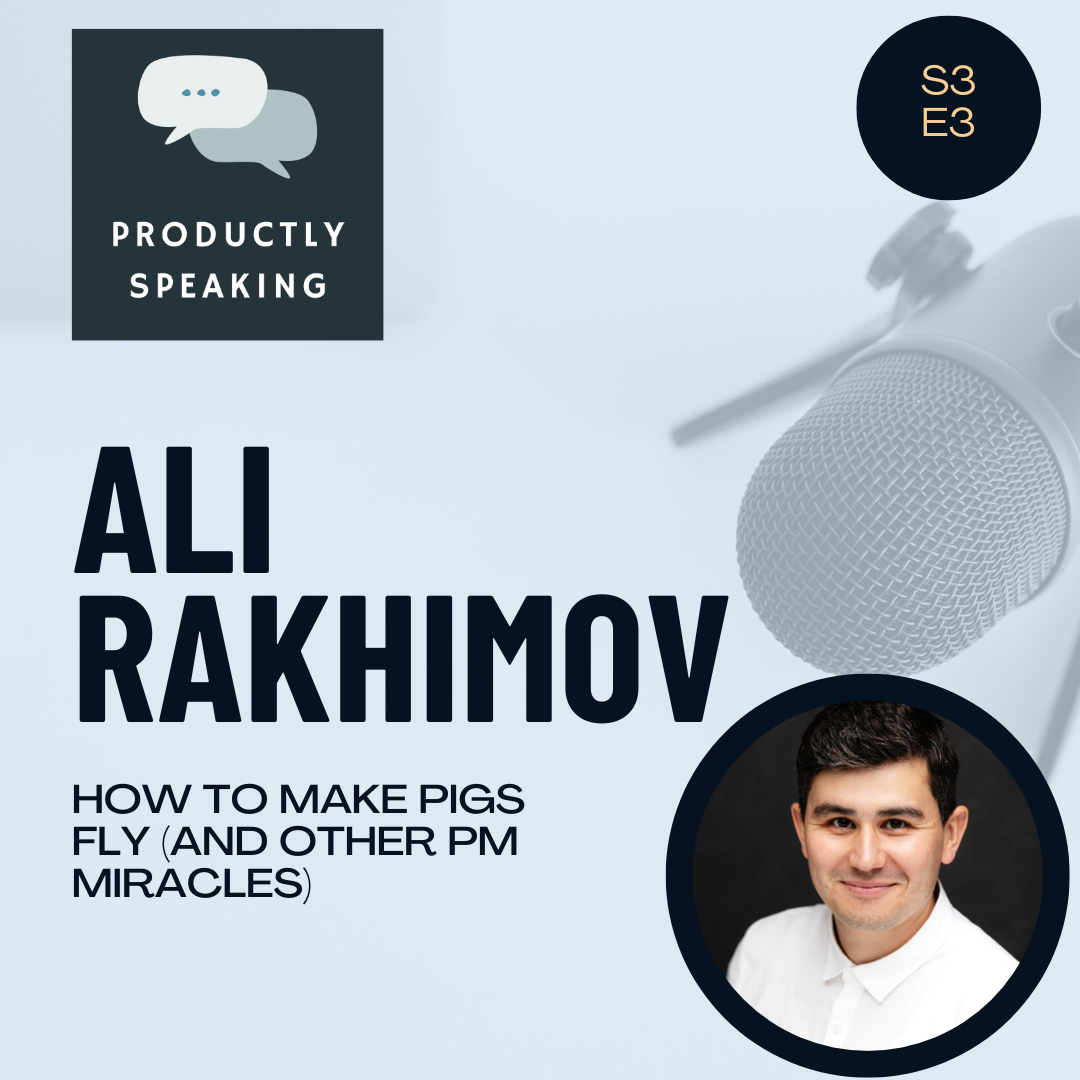


In this insightful and entertaining episode, Karl Abbott sits down with Ali Rakhimov, author of Make Pigs Fly: Product Manager’s Bathroom Book. Ali shares his unconventional journey into product management, his philosophy of “blue-collar product management,” and how storytelling, curiosity, and resilience shape great product leaders.
Key Topics Discussed
- Ali’s Origin Story
- Blue-Collar Product Management
- Communication & Storytelling
- The Power of Idioms
- Features vs. Outcomes
- Building Confidence
- The Role of Humor
- Product Management Beyond Tech
About the Book
- Title: Make Pigs Fly: Product Manager’s Bathroom Book
- Where to Buy:
- Ali’s Website
- Amazon
- IngramSpark
Key Quotes
- “I didn’t stumble into product management—I tripped, fell, and landed face-first into it.”
- “You don’t need to speak louder—you just need to translate better.”
- “Good PMs ship features. Great PMs ship belief.”
- “You have to be fearless. You have to be hungry. That’s how you grow.”
Connect with Ali
LinkedIn: https://www.linkedin.com/in/arakhimov/
On today's episode, we'll be talking to Ali Rakamov, the author of the product management
book, Make Pigs Fly, which sums up what I think I do every day as a product manager.
We'll dive into Ali's journey into the profession and explore ways to enhance our communication
and storytelling skills.
Ali, a self-proclaimed blue-collar product manager, has over a decade of experience in
the tech industry, focusing on practical solutions that make a real difference in people's lives.
As a bootstrap founder with multiple successful exits, as well as a product leader and coach,
he believes that anyone, regardless of their background, can create great products by staying
curious and learning from others' mistakes.
Ali, welcome to Productly Speaking.
Thank you, Karl.
Thank you for having me.
Tell us your story of how you stumbled into product management.
Yeah, I like to say that I didn't stumble.
I tripped, fell, and landed face first into it.
No title, just a lot of problems nobody wanted to solve when I was in K-12 trenches.
I just wanted to solve them.
There's some curiosity and maybe got an entrepreneurship it, but this is before I knew the whole product
management existed, before I knew about this whole startup slash tech world.
Yeah, just seeing little Johnny's cash disappear in the front office of a school is what kind
of inspired me to kind of address that problem.
Yeah.
So why do you call yourself a blue-collar product manager?
Yes.
What do you mean by that?
Great question.
And I actually think about it.
It's been evolving, the definition.
But to me, after over 12 years now of being in tech, one of the things that I see quite
a bit is PMs who, what I call kind of reading teleprompters, right?
Like there's a journalist who does research, investigates, kind of gets to the trenches of the
story, to the location, and does a lot of investigation, kind of dirty work.
And then there's people who just read from the teleprompter to relay the news.
And for me, blue-collar management means is that you're a builder by nature, whether
it's a startup, whether it's your tree house in your backyard or whatever hardscape you
do in your backyard, you're just a builder.
You see a problem, you can go and just kind of tinker with it in your garage, in your kind
of back patio.
Initially for me, as somebody who just started a company, went to China, like connected some
peripherals, built the software without doing anything.
I like that process because I made a lot of mistakes and I learned from them.
Not only that, the second kind of point where I talked about evolving of blue-collar, blue-collars
are just like plumbers, electricians.
They take care of a specific problem and they do it with kind of business in mind.
You don't have unlimited amount of money, right?
You don't just happen to spend someone else's money.
So blue-collar PMs tend to be more resourceful, do a lot more with less.
So that's kind of my quick definition of blue-collar product management.
Yeah, that really resonates with me.
I mean, on this show, we've spent some time talking about how it's the people that have
that desire to tinker and actually understand how things work and really kind of get into
the guts of something and understand it, that that's really what makes a good product manager.
And we've kind of talked about, do you have to be technical to be a product manager?
And it's like, well, if the product is technical, the answer is almost undoubtedly, yes, you should
be technical to some degree.
You should understand your product.
You can't just be the person that doesn't understand the product or that, you know,
only has that teleprompter level knowledge.
Like, okay, tell me what I'm supposed to say and I'll say it.
And don't ask me questions, please.
You don't want to get into that spot.
And yeah, when you find yourself in that spot, that's a time when it's time to start digging
into working with engineers and the people building your product and ask the questions and
say, hey, you know, help me understand where I've found myself.
Because yeah, without that skill, it can be very difficult to make the right decisions.
You're spot on.
And that's the whole essence of it.
And experience that doesn't just come.
You have to go from not knowing something to knowing something.
And sometimes it's ugly.
Sometimes you make mistakes.
I've made a lot of mistakes, by the way.
One of the stuff that I'm proud of is I made most of those mistakes with my own startups
and it was my own stuff.
So I think that's where once we get into this bubble of product management, sitting in the
office and just doing stuff, blue collar means it's like you actually get out of that
bubble.
You go and meet your, whether it's end users on Reddit, whether it's your internal stakeholders
when you do some kind of trying to optimize Walmart returns or whatnot, right?
So it's that getting out of the bubble and kind of being close to your customers.
Yeah, the Pragmatic Institute calls that the HITO.
Nothing interesting happens in the office.
Realistically, I mean, you can sit in the office and create slideware all day and do that for
a living.
But if you're not actually getting out there, like you said, and talking to the customers
and you're not actually going and trying to understand what problems real users have,
then you're not getting one of the key inputs that differentiates a product manager from,
I don't know what you would call that if you're not doing that, because it's such a key part
to product management.
Swiss army knife type of toolkit.
You know, you're going to be one dimensional.
Yeah.
And you never know what a customer is going to tell you or what you're going to uncover
by talking to a customer.
So it's always a fun time to go talk to customers and just sit back and listen, ask a leading
question and then sit back and enjoy.
Then you have something to ponder about.
Yeah, I mean, I mean, I've worked in different industries, right?
Like I started in payments, ed tech, then as I was mentioning earlier in self-storage,
different kind of problems, different user stories, then e-commerce, mobile, you know, all
of them have something else, but, and a lot of PMs, like a lot of kind of influencers
talk about it.
Hey, do you need somebody who is a specialist within certain things or do you need somebody
who's comes and bring some outside kind of knowledge to kind of really poke holes in
certain things that you don't know what you don't know?
I mean, as a PM, you constantly have to be cognizant of both, you know, you can be an
expert, but you just always have to have that open mind and try to do different things.
Yeah.
You kind of want to get a little at all of that.
It's like, do I want this or do I want that?
Yeah, actually as a business, I want every last bit of that because I want to understand the
problem from every single angle that I possibly can.
And if I'm missing something, I want to be able to uncover that, figure out what's going
on there.
And what I think Steve Jobs made it very hard for everybody, because one of the stuff like
early on in my PM career is like, even customers don't know what they want.
And I'm like, oh my gosh.
So now do I have to build all these features and just keep lying to myself that customers
don't need it?
It's a healthy balance, you know, like, because there's some people who do amazing, great product,
but there's a context to it.
There's a timeline to it.
There's a certain customer base to it.
It doesn't mean that you can just uniformly kind of apply it everywhere, you know?
Well, yeah.
And one customer might want something that they're the only customer that wants it.
Exactly.
And if you design for that, then everybody else is looking around going, hmm, that doesn't
really fit my use case.
Could you make it do this other thing instead?
And you find you've got one customer that's willing to buy.
So you can pigeonhole yourself that way too.
But I mean, Jobs is very correct with the iPhone that like, if we asked people what they
wanted, they would have given us all sorts of other things other than what the iPhone
is.
But then once you see the iPhone, especially for the first time, you go, oh my gosh, that's
what I always wanted and didn't know.
That's a magic trick.
Let's be honest.
That is a magic trick to turn that.
Very few companies get to have that type of moment where you release a genre bending
product that nobody's really quite imagined fully yet.
And then they get it and they go, this is what I always wanted.
That's such a rare moment.
I call it a fester horse moment, right?
So if you ask them, oh, I want a fester horse, but there's the whole infrastructure of cars
and what Ford did.
And absolutely.
Another kind of element is I think about those kind of truly disruptive companies is that
refrigeration at some point was disruptive, but made a lot of money, right?
Leveraging, building a brand around it by leveraging all this refrigeration to do stuff.
So you don't have to be kind of the pioneer, you don't have to, but you can create huge
brands and kind of huge companies by leveraging certain innovations.
Yeah, that's, that's a great point.
So I have to say, I love the title of your book, Make Pigs Fly.
First question on the title.
By calling it that, I'm assuming you did the product work to actually determine that someone
would want pigs to fly.
Yes, I wish.
So on a personal note, right?
I don't eat pork.
I've never eaten pork.
So it was like, okay, so do I want to really bring and make the essence of my book, like
being a pig?
So that was like the first challenge.
Like, I'll be honest, like everybody's like, my wife is like, why pig?
Like you can, isn't there any idiom with like ants or something else?
So, but I mean, I loved it.
It's like, it's Make Pigs Fly.
It's like, it just connected to my soul, you know?
Like, yeah, I mean, we are asked, I guess, PMs in our experience.
Sometimes it's a challenge.
It's where, like as you mentioned, Steve Jobs bringing engineering, tell them to fit this
huge battery into this little laptop, right?
It's a challenge.
It seems at that moment impossible.
And sometimes there's other challenges where like truly some private equity company comes
and says, hey, do this, all of this stuff.
And there's no way visibility wise you can do it.
You cannot just switch, lift and shift from legacy, whatever, to modern stack in three
months.
Some of it just sounds so.
I think that's why I was like, I really liked it.
And I just felt that like in a lot of my experiences working in other companies, sometimes
thing like Make Pigs Fly, you know, it resonated with me.
Yes.
Well, I mean, Steve Jobs, not to keep going back to it, but man, when he releases the iPhone
and then he sees the numbers come in, he's got to have kind of this moment like, we made
Pigs Fly.
Yeah.
Yeah.
He truly pulled the trigger and like went with it, executed flawlessly, you know?
And, and that's one of the beauty of it is like, I'm not an iPhone user.
I became a Samsung kind of Android because 20 years ago it was affordable.
I was a very practical person.
And like, I love the storytelling of Steve Jobs.
It's, it's, oh yeah, because he, I mean, the good PMs ship good features, but great
ones kind of ship belief, like belief in the product, you know, like it's almost religious.
And that's what I think what he did and which I love about him.
So the subtitle of the book, Product Manager's Bathroom Book, indicates that this is reading
for a time that hopefully we have to ourselves and aren't instead answering emails.
Tell us more about your choice of the subtitle.
This is not something that I created.
So over 22 years ago, when I came as an exchange student, Arizona has been my hub for 22 years
because it was destiny.
My host family wanted to have a little kid who played soccer from Tajikistan.
And one of the first books that my host father gave me was the Great American Bathroom
Book.
It had a lot of little wisdom, like nuggets of wisdom.
And it helped me with my English, but also like when I would go to school, try to understand
Plato, Aristotle, they were like my spark notes, you know, like, oh, here's what it is.
Okay.
So I understood the context.
I understood all of it.
So that was one of my favorite books because in a very short period of time, I could learn,
you know, the context and learn a lot of things.
And it was bathroom book and it was for bathroom and I hid in my bathroom.
And so that's kind of where I kind of copied the whole bathroom book, knowing that, okay,
so we don't have a lot of time, you know, our time is in meetings lately, right?
Why not just go in and just learn one idiom at a time and kind of enhance our storytelling?
Yeah, no, that's an awesome story.
I love the way that the book has been titled and it certainly, I mean, there's a lot of
creativity to it, but it also shows just a deep understanding of what product is actually
all about.
Those times when you just have to get away.
I mean, you know, we talk about the bathroom book and we laugh about it because we know
the American concept of the bathroom book, something that you read when you're in the
toilet and shouldn't be getting bothered at that time.
There are parts of the product management job where you just have to turn off teams.
You have to turn off Slack, whatever your company uses, turn off the email, turn off
the phone, put all that away so that you can actually do some deep thinking about what
it is that you're getting hit with.
Because I'm sure your product management job is a lot like mine, where you spend your
day being bombarded by all sorts of questions and all sorts of inputs and all sorts of new
twists and turns with your customers, your partners, whoever your end users are.
You get to the end of the week and sometimes your head's just spinning and you're like,
I have no idea what I've really encountered this week.
And if you just spend the time processing it, you'll find that all of a sudden little
connections start to happen in your brain.
And then after enough of this deep thinking time, you start to see some patterns in all
the things that you've heard.
And then that's where you can actually start to make movement.
I love the idea of a product manager's bathroom book because it does reinforce that idea that
part of product management is being the person who's getting bombarded by all the things.
But the other side of it is to get out of that and spend the time just thinking about
all the things.
Amazing.
I love it.
And I think one of the things being an immigrant, you know, English not being my first language,
this is something coming to us, like we always had some, most of the people who try to learn
English, they have some cards, they have some things always with them and they're like
very short.
And so for me, it was always when I, I mean, I felt as an outsider when I joined, I mean,
it was very rudimentary English that I spoke.
It's like, okay, so, and it wasn't about being smart.
It's just, I wanted to make sure that I'm understood.
And I think that's one of the ways for me was like, okay, I wish there was something
like a guidance type of stuff that helped me be understood when I was pitching something
or when I was presenting.
The story of MakePixFly started like five years ago when I was one of the meetings.
And I saw one of the amazing consultants from McKinsey kind of deliver amazing presentation,
which I loved.
I was like, wow, this is so amazing.
I can relate.
I can easily understand.
And he used one of the idioms, juice, not with the squeeze.
And I'm like, oh my gosh, this is amazing.
So that's kind of how it started.
I took notes.
I'm like, that's what I'm going to do.
I'm going to write these idioms.
I'm going to make myself better, but also the context of it, the examples and bring kind
of tech stuff to make sure that other PMs can relate to it and use it.
Yeah, absolutely.
And I was going to come in and ask that, you know, communication is just one of those key
parts of product management.
And a lot of what we've been talking about is communicating, whether it's through your
writing in the book or through doing a pitch to a customer or doing a pitch to your executives
for what we're going to do next.
You've talked about using those idioms as a way to kind of help people wrap their heads
around what they need to communicate.
But what are some other suggestions you have on how we as product managers can elevate our
communication skills?
Just because I read the book, I'm not an expert.
I'm still learning.
It's a journey.
You know, for me, it was just, hey, here's my notes in my journey.
That's how I can perceive my book.
You don't need to speak louder, right?
You just need to translate better.
That's kind of how I kind of come when it comes to communication and influencing.
Give us an example of what that translates better because, yeah, that speaking louder,
I think a lot of people think that, yeah, you can just speak louder.
And sometimes it feels like you should speak louder, but I like that idea of translating
better.
It depends on the audience.
But when you go and try to sell to leadership who doesn't know anything about microservices
or Kafka saying, hey, explaining a backend dependency.
Hey, don't say Kafka cues.
But you say, hey, it's like a Amazon checkout line.
You want everyone in order, not chaos, right?
So those type of little things.
So they understand better.
I really like that idea of simplifying like a larger technical concept that may have some
buzzwords around it into a concept that everybody's going to have an idea of.
And I think for me, like in my journey, specifically with startup, like that's where I can have
made a lot of stuff.
It's like, oh, this is a cool thing, this and that.
But at the end of the day, it has to be instantly understood by the other side that the encoding
and decoding is to be very simultaneous.
And going back to Steve Jobs, that's what he did.
It's like you inspire, once you inspire, like it's already sold.
You already sold, right?
For us, again, as PMs, we need to sell the sizzle, not the steak.
You know, you speak to the outcomes, right?
Not the features.
And that's when I had my startup, I was bootstrapping and trying to sell features.
And I was like, why?
Like, do I suck in sales?
Am I bad in marketing?
Like, what's going on?
That was kind of one of the self-realizations I came to.
I'm like, nobody cares about the features.
They care about what is that sizzle?
What is the vision you're trying to solve?
Once I started doing that, kind of tinkering and kind of practicing with that, I had more
validation and conversion.
We talk about features versus outcome, and that's a fascinating topic.
And it's been written on so much now that it's almost a buzzword in and of itself.
But, you know, you're talking about we've developed all these features.
Obviously, everybody that's pulling features together, when you look at it together, there
is some greater good that you're trying to solve for.
But how do you kind of go from talking about the individual features like, wow, you know,
we spend a lot of time on this is really cool to the, but I know you don't really care about
that.
But when you take all these together, here's where you're going to get.
Walk me through the process of going from a feature-based thought process into an outcome
based.
It's a multiple steps and it's multiple audiences, right?
So it's every company I work for.
That's why I'm like, so personally, I don't like frameworks and certain things because it's
hard to put something in all across the board.
It's generalized, right?
Product management is about interpersonal skills first and foremost.
You have to understand your colleagues.
You have to understand your stakeholders, what drives them, what success means to them.
If I'm building a financial product, I need to understand what CFOs care about.
Maybe it will not be like doing certain things in three clicks, but maybe it will be instant
dashboard to give them certain bottom line numbers.
It's really understanding what makes them happy and what success means to them.
So first and foremost is really understanding it, talking to them, spending time with them.
Second thing is, it's that creating that cadence as you pitch certain things like, hey, you
can have a working session, you can have a kickoff for some initiative that you're driving
and learning from it.
What are the engagement, like getting a pulse check on how certain things is going.
If you're getting too many questions, maybe you're not doing it right explicitly or succinctly
elaborating in your first two slides, for instance.
So for me, it's understanding the personas who I'm working with, what success means to
them, and then practicing it through those cadences and meetings and seeing if I'm getting
too many questions, probably I didn't do a good job in my first two slides or three slides
that I presented because every time I present something, I try to make sure that it addresses
90% of the questions.
There could be some edge cases, but if I'm not doing it, then it's a matter of practice.
So that's how I kind of view it.
And over time, once you will realize that, you automatically know what questions are going
to come and you start kind of filling those gaps.
And so that was kind of my journey.
So then once you actually do start filling in the gaps of the questions that are getting
asked, one thing I think that's really great about getting questions when you're up there
presenting is that you realize that people are engaging with the content, they're thinking
through, they're right there with you.
When you start answering all the questions, how do you know that you've still got that audience
engaged?
That's a great question.
In my experience, sometimes you just are quiet and sometimes you try to poke holes yourself.
You know, if nobody asks questions, you say, hey, what if this happens?
So you kind of fill in the gap to get engagement because a lot of times we talk about product
managers.
Sometimes we have audiences that just do not engage.
They have maybe something else in their head and realization that, okay, it's not your
job to make them talk.
I've been in some cultures where people just don't care.
And that's very hard places to work in where some people don't care.
At the end of the day, you have to then start from the beginning foundational saying, hey,
we're in this boat.
Go back to the objectives and goals.
Do we really want to hit it?
Is this important?
Before you go into talking about features and stuff.
And it's hard.
It's not easy.
One thing I've realized in some good companies where we shipped amazing, like T-Mobile is
one example where they were really ahead in their digital transformation.
I learned a lot from a lot of working with architects.
I was a technical PM and we would ship 20 projects a quarter because everybody worked
flawlessly.
Certain things were time box.
And we would go to those meetings.
People really, it was selfless kind of discussions.
It wasn't about who you are, what you say.
It was really selfless discussions.
And focus was on winning together.
And that was one of my favorite kind of places to work because it was true teamwork in action.
Even if when you made mistakes, they'll say, hey, it's okay.
It's like, maybe we'll think about it next time or other things.
A lot of folks were really sharing their knowledge.
And I was a kind of PM who just started.
It was really hard because some people just don't share.
They might look at knowledge as like, that's the only control they have.
When they don't ask, it depends on the situation, I would say.
But it comes down to like, is what you're going to talk about, is it going to move the
needle?
When it comes to meetings as well, I try to make sure if it's not going to move the needle,
what's the point of kind of wasting your energy?
Well, I'm talking about moving the needle.
One of the ways that we can move the needle is through telling stories.
Nobody wants to sit there and listen to you read off of a slide of like, these are the
latest features, especially if it's technical features.
That's a quick way to want to take a nap in the middle of the day.
Storytelling skills help bring this alive.
And we were talking a little bit ago about that features versus outcomes.
What are the ways that people can build better stories just in their day to day and improve
those storytelling skills so that they become a more effective communicator?
Hey, I'll say they need to have kids.
As a person, you always sell.
You always sell, even if you don't look at it as like transactional.
I have four kids and whether going to the park or doing homework or eating certain healthy
foods that they don't like, it's always about selling, right?
It's always about some kind of barter, some kind of transaction.
My son was born when I was 21.
So from a very young age, I knew how to start selling and talking and trying to understand
what levers to pull and what carrots to put, you know?
So my personal loan is like, it's through my kids.
Another thing is you have to be hungry.
That's one of the stuff I say is if you're hungry, you'll find different ways to kind
of approach certain things.
You will try different things.
A lot of people in my experience, a lot of PMs are just afraid to ask questions, silly
questions.
You should never be afraid to ask silly questions.
If you start practicing that journey of asking silly questions, not being afraid of how people
perceive you, right?
Because that's another thing.
When you don't know me, I'm an expert.
I haven't heard that one.
But once you get to know someone, you're like, okay, so I think Ali is just fluff, you
know, he just talks about it and he's like nothing.
So a lot of people are cognizant of it and try to speak less to kind of manage that.
But at the end of the day, you have one life, you're working here, you're in this boat together.
You want to do something like ship something that really matters.
You want to look back and say, hey, we didn't just create this microservice.
No, you want to say, hey, it impacted a hundred thousand people till we built this backend
that allowed authors to write a hundred thousand books type of stuff, right?
You want to have those stories.
You bring up an interesting point, and that is just that we all have our own perceptions
of ourselves.
And a lot of times we have imposter syndrome and we tend to not think as highly of ourselves
as others might.
And we don't realize how much of an impact we have on other people.
And part of how you get there and part of how you get out of your imposter syndrome
yourself is through those storytelling skills.
I mean, being able to tell a good story, being able to keep people engaged and connect with
them.
And really, you know, with the imposter syndrome, fake it till you make it.
I mean, you may feel like an imposter, but that's probably the best sign that you're actually
who you think you're not.
And one of the things for me, it was like, and you have to go through this journey mentally,
you know, like psychologically, you have to go through this journey of failing.
And like, I can't tell you how many times I told a joke and nobody laughed.
And it's like, oh my gosh, I'm never going to tell a joke again.
You know, and that's right.
You got to tell how many bad jokes till you finally tell a good one, you know?
Yeah.
Engineer walks into a bar, you know?
Yeah.
But I think it's human nature to kind of have those traumas and then those traumas kind
of driving you.
But you have to be fearless.
That's why I say you're hungry.
Like you have to be fearless to continue doing what you're doing because you have a bigger
kind of purpose in life.
You have a bigger purpose to work with those colleagues.
There's a reason you're there and you want to make sure that you are not afraid to be yourself.
The psychological safety net around you gets better and it's contagious too.
Other people kind of open up and kind of do that.
But it takes practice.
It takes somebody to be a little bit vulnerable and then others kind of open up and kind of
be themselves.
And that's what I feel is like people trusted Steve Jobs, you know, like no matter what it
is, like people trust.
And to build the trust is the first step of really making sure that your communication
is not a fluff, that you're a credible person.
If you say something, you're going to do it or you're going to show some effort.
So communication is not just saying things, it's walking the walk as well.
Yeah, well, I mean, he came into Apple after it had just about fallen apart.
And I mean, he'd been part of Apple before, but he left and he came back.
And when he comes back, it's just a mess.
The products were boring.
He's looking around going, we've got one shot.
We have to get it right.
And he told the company, I'm paraphrasing because I don't remember exactly what he told
the company, but he basically told the company, we're going to change the products that we
make and we're going to make products that people want.
And we're going to go out there and we're going to sell the best out of these products.
And that's exactly what he did.
He turned the company to a point where people all of a sudden wanted Apple products.
I mean, those original iMacs.
I can remember the clamshell commercials for all that and people going crazy because they
were colored.
I mean, PCs were beige, computers were beige, and now you've got colored computers.
And who knew that people wanted colored computers, but those things sold like hotcakes.
And there were a lot of them out there.
You're absolutely right.
Jobs came in and he knew that the window to do what he needed to do was closing, that
it was a very difficult task.
There was a high chance of failure, but when else in life are you ever going to get that
type of opportunity and why not right now?
And so he just did it and that he succeeded.
He was very lucky.
I mean, there was a lot that went into that and just reading the market and having the right
people in place and having a solid understanding of what people wanted and actually solving problems
that others weren't, you know, making creative devices.
Apple's always been kind of the computer of the creative.
They really played that up.
And then you get the iPod.
And after the iPod, you get the iPhone.
And a lot of stars had to align for it to kind of to happen.
It was a kind of beautiful moment.
But I mean, when we think about it, another angle that I try to kind of approach when we
talk about Steve Jobs and there's a lot of several movies about him, right?
We kind of get different angles.
He was a hard person to work with, right?
Yeah.
You hear the stories of how he treated people and like what he would say and things like that.
You didn't want to be on Steve's bad side.
Yeah.
And so that's why another element to kind of product management is don't be silent.
Talk, right?
Nobody wants to be perceived as a bad person.
There's a lot of times that I was like, I would go and just boil the ocean just to understand
what happens, you know?
We want to be perceived as nice people.
We want to be doing it.
But at the end of the day, I look at it.
Okay, we can have this Kumbaya moments.
But the customers who rated your app 1.7, like how do we help them, right?
How do we help grandma make a payment on this Macy's card that she's struggling and she's
actually still going to the store to make a payment type of stuff, right?
So you have to care about the customers in those organizations sometimes, like even though
you will have a good collective kind of happiness, but if customers are not benefiting from it,
then what's the point?
Well, you have to be ready to say no.
Pushing back is one of the things that I learned kind of the hard way after getting
burnt out.
I'm going to really go crazy or I'm going to say no.
And it's very counterintuitive once you start saying no.
People respect you.
They value your time more, which is very counterintuitive.
Like to me, it was.
Well, and it doesn't feel good to say no at first.
Yeah, yeah.
You want to say yes to everything.
You want to say, yeah, I can do that.
Yeah, I can do that.
Yeah, I can do that.
You want to be an order taker.
And that's one of the stuff is like when I talk about it is like blue collar, they are not
afraid to just be themselves and say no.
And you take your craft seriously and you're not afraid of pushback, you know, and but
you do that pushback with insights, with empathy and data.
I just say, here is why.
Great conversation on that.
Yeah, absolutely.
Thank you for that.
So what inspired you to write a book?
As an immigrant and someone who didn't belong in this field, like the way I perceived at
that time, I wanted to write the kind of book I wish I had when I started.
But quick, honest, and one of my bucket list items is kind of comedy improv.
So I liked humor.
Like I believe humor kind of is the best medicine.
So I wanted to make it a little bit funny and just not just another dry textbook that
collects dust, you know.
So that was the whole thing is I wanted to make sure to do something for myself.
It started as.
And I wanted to make sure that it's relatable, right?
A lot of stuff when we read, it's like one company, this, like a lot of things, right?
We have PMs that do not work in big enterprise companies.
They're like little small product managers that might never understand what Apple or
Google PMs do.
But I wanted something that's kind of more common for kind of common peasants, you know?
So because I was working in startups, little kind of companies and a lot of stuff that
I would hear is like, I cannot relate to.
It's like, that's not how it works, you know?
Yeah, there's a lot of people that would like to just beat you over the head with the,
this is how they do it at Google.
It should work that way everywhere.
And it's like, but that works at Google, but not necessarily at my startup, not necessarily
at my midsize company.
You know, there's a lot of places that they just don't work the same way as a big tech
firm.
And product management can be molded to a bunch of different disciplines and it can be molded
to things that aren't even software, which you hear so much stuff about software product
management that you don't even realize or think about like manufacturing product management.
I was recently at a period where I was looking for new jobs and I was looking at people that
did like product management for tractors.
Crazy.
You want to go build new tractor products.
I mean, think about that.
That's a whole different world than software.
You're talking about what types of features you're going to add to the next generation of
tractors to sell to farmers and others that are keen to see what the new models are going
to have.
And it's just, it's very different than software, but it's still, there's so much that's the same.
But again, I'm a software guy.
I have been on a tractor, but I'm not a tractor guy.
So to take a tractor product management job, I'd have to learn quite a bit about tractors
and how they're put together and where all the parts come from and how those parts are
manufactured.
There'd be a lot of new ground that I'd have to learn.
I would be the person going, please give me the cue card and tell me what I'm supposed
to say to this group of farmers about this tractor.
So it would be a bit of a stretch to get into something like that.
But it is really cool how the discipline can stretch into a whole bunch of different
areas.
And I think lastly, kind of to your question is, as you mentioned, like imposter syndrome,
right?
All of us are different, right?
I wanted to make sure that this book is a kind of confidence post that you belong.
In K-12, as I was a kind of dean of students, one thing I learned and the mantra that we
always within educators, we say is like, don't judge a fish by its ability to climb a tree.
And I like that one.
Actually, I just thought about that.
It took me a moment.
It's like, don't judge a fish by its ability to climb a tree.
And it takes time, you know, like it takes time.
And a lot of us like have to work several jobs to find our perfect fit.
And just because you go somewhere and you work and like you mentioned tractor, it's
like you, they put you in that, like, listen, life can throw curveballs at you where you
will have to take those jobs for some reason and you find yourself there.
You can do your best, but it might not be like, just because you are not good at it doesn't
mean you're unsuccessful as a person, as a professional.
It's just their forte lies somewhere else.
And it's a matter of timing until you find that.
So for me, it was like making sure that people understand that it's okay to fail.
It's okay to be a mistake.
And it's okay not to be doing certain things, but never lose confidence in what you can do
as long as you can ask questions and have hunger for learning and really empathetic to
understand the problems.
Yeah.
Thank you for that.
So Ali, where can our listeners go get your book?
My website.
This is another journey.
It's like, oh my gosh, building your website.
So I never thought it's going to be that hard.
Oh, there's a lot to a website.
Yes.
Yes.
So Ali.ink is my personal website where I talk about different kind of my garage, my
other ideas, but that's where I have some links for books.
Of course, Amazon KDP is where most of the folks start with.
It was very easy.
So that's where I kind of started because it was easier to publish there.
I also published through IngramSpark, another kind of platform for those who don't know.
Very nice.
Amazon has my book.
Thank you.
Very good.
And just one final personal question to let the audience get to know you a little bit
better.
What is one goal that you hope to achieve in the next year?
Great question.
Yes.
So I'm working on my backyard.
I want to learn, and this is very interesting.
I want to learn how to build kind of block fences and pavers, how to lay pavers myself.
It's always easy to hire someone, but I'm trying to be, I want to make sure that my hands have
the skills.
It's not just in my brain.
I want to do something with my hands.
Over the last two years, I've been kind of working on what I can do myself, like learning
how to do framing, learning how to use the chainsaw to cut the trees.
Even if, let's say, I get laid off in tech because AI will replace all of us, I want to
go and be able to build walls and maybe pavers.
No, that's good.
And I think it just goes back to that, what we started talking about with, you know, wanting
to tinker and wanting to understand how everything works.
And that being just a very key facet of being a successful product manager is wanting to
kind of dig in and understand all the nuts and bolts of how something's put together,
as opposed to hiring somebody to do paver work for you, actually understanding what is
it that they're doing?
What do they know?
What am I paying them for?
And understanding that you may still ultimately decide that after that, oh yeah, I think I'll pay
somebody to do that the next time, but at least you'll have a better appreciation of what
it is that they do.
At least you tried.
I know that's the most important thing, you tried.
Yeah, that's a great one.
Yeah, thank you for that.
And thank you for coming on the show.
It's been good to have you here.
Oh, my pleasure.
Thanks a lot, Karl, for having me.
Yes, I really enjoyed it and good to meet you.

Ali Rakhimov is a self-proclaimed "blue-collar product manager" who has spent more than a decade in tech, focusing on practical solutions that make a genuine impact on people's daily lives. After wrangling everything from payments and hardware to SaaS and eCommerce, he discovered that silly questions and deep empathy can move mountains-or at least Make Pigs Fly. As a bootstrapped founder with several exits and a product leader and coach, he believes anyone-regardless of pedigree-can build great products by staying curious and learning from others' mistakes. That philosophy led him to write "Make Pigs Fly" so readers can skip the painful lessons and focus on what works, while polishing their communication prowess. Swing by www.ali.ink to learn more, share your own idioms, or snag some MPF merch.