

S2E3: Navigating the Intersection of Product and Marketing with Austin Fuller
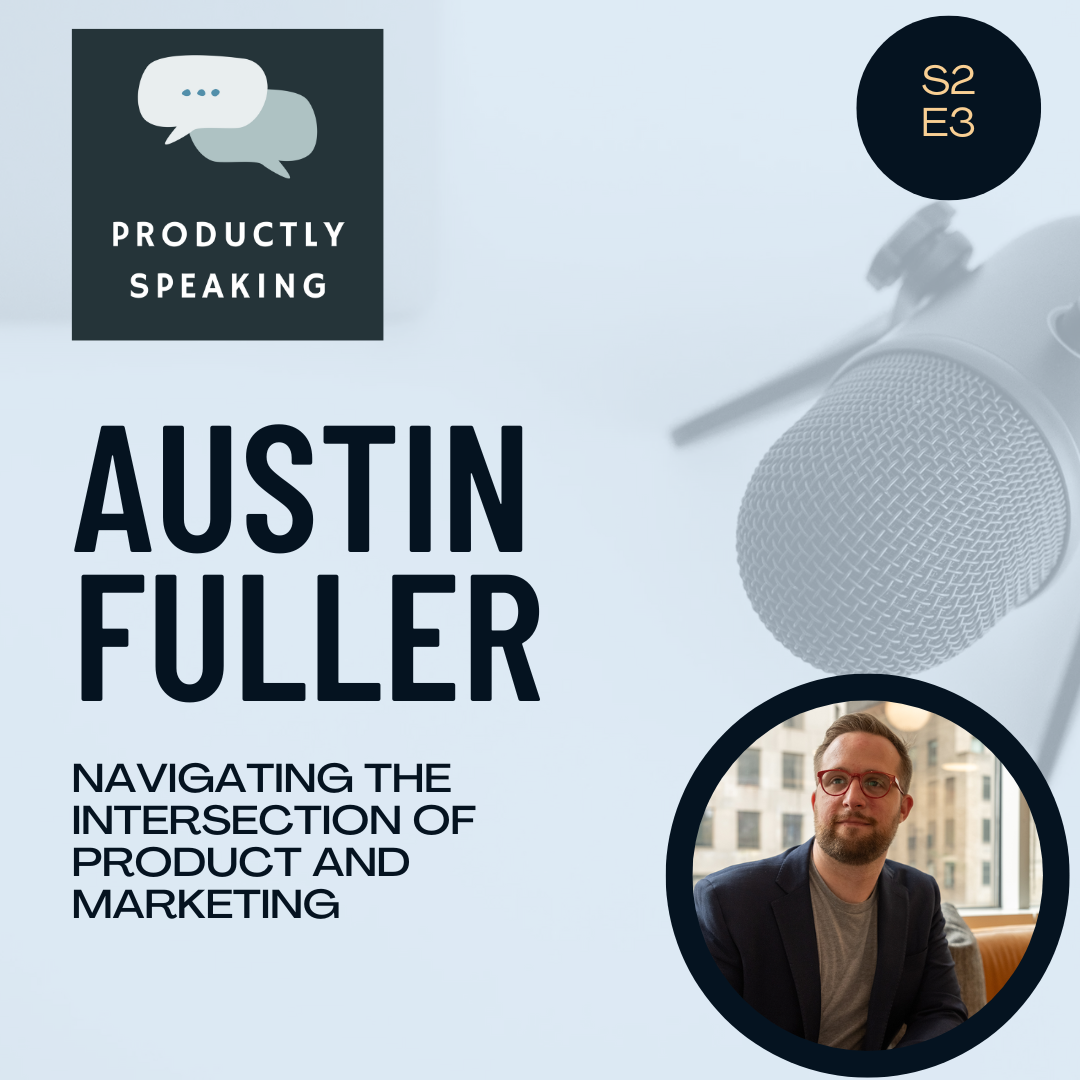


In this episode, we dive into the vital relationship between product marketing and product management. Our guest, Austin Fuller, a go-to-market expert with over a decade of experience in technology, shares his insights on how these two disciplines intersect and why getting this relationship right is crucial for business success.
Key Topics Discussed:
- Defining Product Marketing
- Techniques in Product Marketing
- Differences in Feedback from Prospects vs. Customers
- Types of Product Marketing Roles
- Importance of Customer Feedback
- Aligning Sales, Product, and Marketing
- Product Lifecycle and Marketing Focus
- Challenges and Solutions in Product Marketing
Memorable Quotes from Austin Fuller:
"Product marketing is taking your understanding of the product and the magic of the product and taking an understanding of the market and connecting the two."
"A lack of alignment with product and marketing creates a lot of dysfunction for the customer. Expectations for the customer become misaligned with what you can deliver, which results in churn."
"It becomes difficult to launch products and features when product and marketing aren't working well together."
Call to Action:
Follow Austin Fuller on LinkedIn.
On today's episode, we're going to talk about working with product marketing and why the intersection between product marketing and product management is one of the most important to get right.
People tend to view marketing as a disparate discipline from product, and today we're here to explore whether that's really the case.
Our guest today is Austin Fuller, a go-to-market expert with over a decade of experience specializing in technology.
Austin has worked with early-stage venture capital and private equity-backed SaaS companies.
He has successfully driven revenue growth for numerous companies by understanding customer needs and leveraging that insight to collaborate with his product team in addressing those needs.
I'm pleased to welcome to Productly Speaking, Austin Fuller.
Thanks, Karl, very much. Excited to be here.
So, Austin, let's get started with just a very simple definition. What is product marketing?
Is it just making pretty websites and writing catchy headlines, or do you have a little bit more nuanced version of it?
That is a lot of the output, actually, but it is a little bit more nuanced than that.
I've heard a couple of definitions, and I really like this one where it says product marketing is taking your understanding of the product and the magic of the product and taking an understanding of the market and connecting the two.
That's kind of how I see it is, how can we bring the market and your ideal customers to understand what makes the product magical, different, better than other products?
Yeah, what are some of the techniques that you employ to do that from a marketing perspective?
From a marketing perspective, you know what's really fun about being in product marketing is you get to dip your toe a little bit into the product management side.
A lot of the tools I use, I think, are very similar to how UX researchers and product managers determine what to build, right?
So, having customer interviews, gaining customer feedback through surveys.
I even conduct interviews with prospects, people who aren't paying customers.
I'll try and talk to people at shows and in person or in other forums where people are and I am and gather feedback that way.
I think another good area as well is speaking to industry analysts.
We work a lot with Gartner, Forrester, industry-specific analysts that are relevant to the industry verticals that you work in.
But ultimately, the North Star for us is always the customer, whether that's in my current role at Exeger or anywhere I've been.
People who are actively paying you for your software and using it every day, or perhaps not using it every day,
are excellent sources of truth for what your product is to them and feedback for what you should build.
Yeah, you said something very interesting to me, and that is that you like to talk to prospects.
What type of feedback do you get from prospects versus feedback from customers that are already paying customers?
Yeah, excellent question.
So, I think there's a big difference between the two as far as when you're talking to a prospect,
they don't have much of a filter, which is great because they're not paying you.
There's not any skin in the game, right?
They're not worried about offending you, or if you have a customer success manager or someone,
they're not going to ruin a relationship or burn a bridge for someone that's really helped them before.
So, I think for that reason, they're really great.
Another key difference, though, is that they often need a lot of coaching so that they are seeing things from a similar perspective.
And what I mean by that is, you need to be able to set the context correctly to get specific types of feedback if you're looking for more specific feedback.
Otherwise, it's oftentimes really interesting for me to see, hey, if I ask a certain type of question or I'm asking something more general, where does their mind jump?
What is the first thought that they have?
Because oftentimes, customers have already been marketed to, they've been sold, they're using the product, they're already seeing the world through your lens a little bit.
Being able to see somebody who isn't actively being sold to or actively a customer, where does their mind jump?
What is their perspective on certain use cases or problems in an industry?
Do they even think those problems are important?
Those are all really important things that you can really only glean from someone that hasn't been tainted by your product and your messaging and your marketing already.
No, that's an excellent point because they are going to have different perspectives and it's neat to get that different perspective.
And then wonder, is that something you ought to address?
Is it indicative of a bigger part of the market?
Sure.
And another part is that you get to hear a little bit about what the impact of parallel platforms or tools marketing on them, right?
So what do you use?
What are they a customer of?
That's often a question that I ask is, okay, what is the technographic makeup of this person?
What are the tools that they're in and using?
And why?
What drove those decisions?
If you're curious, talking and engaging with customers is really, really fun and very, very interesting.
There's never a boring conversation that I have.
The well is deep.
You can go a lot of different ways.
It is important to have a disciplined approach to it because you can get questions, schizophrenia, and be all over the place.
And you can talk about a lot of things but have nothing valuable to go use.
Yeah, so to avoid questions, schizophrenia, do you like to have kind of a set of prepared questions in the back of your mind?
Or do you just kind of see what the person says to you and then kind of play off of that?
For customer interviews, they're very planned.
Typically, we're doing research for a specific problem or we're looking for a specific outcome.
We might be trying to launch into a new industry vertical, taking product success that we have in one industry and try and replicate it in another.
We might be launching a new feature.
We might not be getting traction that we want.
There's a variety of causes, right?
But you build your question set based on what is the challenge you're trying to solve and where do you think those answers are?
And then, yeah, have a very specific set of questions.
Now, do I stick to those questions 100% of the time, not deviating?
No, not always because it's a discovery, right?
Much like an explorer makes landfall and starts navigating around.
They have a plan initially, but whatever happens, what they find may lead them in a different direction.
You should have a structured approach, but be flexible and be able to deviate based on the findings and responses you get as you're conducting the interview.
That's entirely unlike running a podcast episode like what we're doing here.
Yeah, exactly.
Yeah, you've got to be able to shoot from the head.
Yeah, we may go different directions than what's in the documents.
So, yeah, very, very similar.
How do product managers best leverage product marketing?
You know, there's a number of different types of product marketers and a number of different types of product managers.
Obviously, you've talked about both sides of the marketing discipline where you've got customer research and market research,
but also generating materials for that market to consume to understand the product.
How does this really kind of work when you've got product managers kind of over in one part of the organization sometimes and marketers over in another part?
How does that best fit together?
So, a couple of things.
One is understand what type of product marketing organization that you have.
Like as a product manager, if I'm looking, hey, how do I work with product marketing?
There have been roles that I've either had or interviewed for or just peers that I know.
And these are kind of the buckets, right?
There's really three categories that I see.
And there's probably others.
But the ones that I see most frequently is this is how product marketing is structured.
One is a blended do-everything role, which is really common.
That's the one that I've held the most, where you're responsible for both product and marketing side responsibilities.
And what I mean by that is very often product marketing is structured to be this,
Okay, we need go-to-market help.
We need to create collateral content messaging.
And we need you to talk to customers and figure out what those things are.
A little bit of market research, analyst relations.
But then there's also the in-app performance.
Especially if you're a product-led company, I would expect the opposite to be true.
You may be creating less content and collateral.
And you are going to be looking at the buyer journey more.
What's the conversion rate from our free option or free trial into paid?
What are the points of friction where looking at something like Pendo,
more intimately tracking where people are clicking, what their behavior is?
A lot of that sounds like things on the product side of the house.
So understanding, do you have a product-focused product marketer where
they are focused on behavior in the product?
Do you have a go-to-market-focused product marketer where they're focused on
supporting sales, creating content, the website, right?
Everyone knows product marketing writes the homepage messaging and all of those things, right?
So do you have a more siloed product marketer?
Or do you have a blended one?
Because if you have a blended one, it's going to be a tug of war between product and marketing.
And there is a delicate balancing act that the product marketer has to do.
So you have to just take that into consideration.
So it's a long answer, but it sets the context for my response, right?
So understanding how your product marketer is,
how the role is defined and measured is really important.
And then you can go in and see where do you complement and dovetail into that.
So at Exeger right now, I definitely sit in a blended role.
However, the priority is a little bit more on the go-to-market side right now.
Some of the product managers that I work with,
they're some of the finest I've ever worked with, by the way.
They have looked at and said, hey, so here's a use case we have in our platform.
We have a database for Section 889 compliance,
which is essentially a list of companies that the federal government is not allowed to do business with.
And one of the use cases for our product is that companies can run a check against their suppliers
or prospective suppliers to check and see if they're on that list.
That was a use case I was unaware of.
It's also a use case we don't have in our messaging or on our website.
So a product manager actually said, hey, here's the capability.
This is how it works.
And we're very differentiated in that nobody else has this list in this database and this data that we do.
You should definitely put that on our website and in your messaging.
I think that was a really good example of a product manager being proactive.
I was onboarding at the time.
It was within my first 90 days.
That was very, very helpful to me because then I'm able to take it and put it into messaging
and get more customers that want that use case, which leads to better adoption,
which leads to better performance for that product marketer's product line,
which is a win for everybody, right?
So I think that was a really good microcosm of understanding where my role was,
what was really important to me, and being proactive about how to work with product marketing.
And that's kind of the dream scenario.
Yeah.
Yeah, that's a good one.
One of my previous companies called Viking Cloud, where I was at,
we had really good product manager, product marketing collaboration.
We were lockstep there, which is one of the reasons I think we were able to grow so quickly.
I was able to do the go-to-market and the market research side
to the point where I was invited to sprint planning meetings and lots of other product meetings,
bringing those insights in like,
Hey, these are the surveys we've done.
These are the interviews we've done.
These are some things that you can actually put in to justify some of the JIRA tickets
that you want to put into this sprint.
I think that's really important as far as what product marketing can do
and what you can ask of product marketing.
Here are things we're thinking of building,
or here's things people are telling us we have to build.
Can you get us some justification for that?
Can you find justification?
Is there market validation for some of these things?
What are competitors selling already?
And bringing that in, like product marketing can be really, really good compliment
to take some of the risk that comes from the guesswork you have to do.
Because like, let's be real, there's really no way to define with certainty
that a product is going to be successful, a feature is going to be adopted.
Right, like we like to say there is.
Just guesswork to some degree.
If you, like there's just so, maybe guesswork's the wrong word,
but there's a level of uncertainty.
I think that you can leverage product marketing to remove some of the uncertainty and risk.
It's an educated guesswork.
It's not just straight, let me wake up this morning and see what feels right.
It's actually educated guesses because we've seen these trends,
we've seen these signals.
We're going to respond to those in a way that we think is going to actually address what we're seeing.
And so it's, you never know for sure if you've got it right until you know.
But yeah, it's very educated in that regard.
And that's a great explanation of how like product marketing can help support
that product strategy and defining a product roadmap within a company
to really kind of drive that product to the market to meet those customer needs.
So thank you very much for that.
You talked about go-to-market product marketing manager people
and also the other type being more product focused.
For a company that's just getting started, say doing a zero to one
versus a company that's got a product that's maybe a little bit more mature.
Is there a time in the product lifecycle where
one type of marketer is more important than the other?
If you're zero to one, I would look at, okay, what's your revenue model?
Are you product-led? Are you sales-led? Because the revenue model is going to define it, right?
But as you get more mature, the company gets larger and the justification comes that you do need both.
And I think there's value in specializing it.
If I were to be at a larger company that had mature product lines,
one, I want someone that is going to make sure these things get adopted,
that we're driving revenue through the product.
Just because you have a sales-led motion does not mean you can't have a product-led upsell motion
or cross-sell motion.
At Viking Cloud, that was part of what I think made the growth so successful was
we added product-led things once we had sales-led established.
Look, zero to one, there's a lot of uncertainty.
You have the founder has an idea of what will work,
but very likely it'll be something radically different.
I would say you want somebody that can do both,
especially if you're product-led, you need somebody that's going to be able to write
and do good copywriting, create good content,
or good enough content at the start to get resources in to tell the story,
to get people in to the product.
And then you need somebody that knows how to set up Pendo or a similar tool,
or knows how to look at,
okay, what is the time between somebody logging in and then logging back in a second,
like setting up their profile and logging back in,
or heat mapping, understanding what they're clicking on,
what they're doing, what the behavior is inside of the product,
to hopefully create content that keeps those users engaged
or find other ways to engage them so that they convert into paid.
If your sales-led becomes much less important to have a mixed skill set,
as somebody who leads product marketing as a function,
very often we're asked to do a lot with less resources, right?
The discipline itself is rather new in the sense that
there are vice presidents of product marketing.
Product marketing has kind of become a standalone function.
It used to just be like,
we have the marketing function and we have a product marketer
or product marketers under marketing umbrella.
I think for me, looking at the maturation,
I don't know that one becomes more important over another,
but the resourcing to specialize,
just like any function, becomes available.
For me, as a product marketing leader,
I want to drive revenue from both sides,
from both pre-sales and from post-cross-sell, upsell adoption,
because ultimately, we don't want churn.
I've been in SaaS, software as a service, for those who don't know.
So for us, we live and die by the subscription, right?
Which means we can't have churn.
Churn needs to be as low as possible.
And product marketing helps both of those things.
And I don't want to say that I can nail down exactly when product marketing
and customer marketing become bifurcated,
or when you for sure dedicate resources into building out your product side,
product marketing.
But it is very important.
And initially, when the business is small,
and just trying to grow and trying to validate,
I would say, yes, go-to-market is probably more important,
because you want to be able to build repeatability
and validate that the way you go to market is correct.
And therefore, your product is correct, right?
You're trying to find product-market fit.
Post-product-market fit, now you're like,
okay, we have a product that fits.
How do we get people to use more product and buy new products, right?
Hopefully, that's what's going on as a part of product management too,
is we're informing roadmap, we're tracking what people's behavior is,
and we're building features based on problems we're hearing from our customers.
Well, it's kind of interesting from what you've said here,
and something that I've not necessarily thought through a whole lot,
is just kind of the interaction with sales and marketing,
and how that's sometimes separate from the interaction of sales and product.
And I've certainly seen scenarios before,
where you're trying to find that product-market fit,
and sales has their list,
because sales is going out there with prospects,
and they're coming up with,
hey, if we just did X, we could sign this much of a deal.
If we did Y, we could sign this big of a deal.
It doesn't always play out that way, unfortunately.
But, you know, sometimes the things that they're asking for,
that prospective customers are asking for,
isn't really the direction where you, as a product team,
want to actually take the product.
But marketing seems to be kind of stuck in the middle of that conversation.
So tell me how marketing can help both sales and product kind of navigate those waters.
Yeah, wow, that's great.
And hopefully we can get to the answer here.
This will be a real...
This may not be an answerable question.
Maybe it's just a general direction you want to get to.
No, no, I think it's a great question.
Because, yeah, we do often get stuck in the middle.
And product marketing is square in the center of that middle.
Sales loves to say, we need this feature.
We would have $10 million in revenue if we could just build this feature.
There's so much business behind this backlog.
Please prioritize it, right?
Sales has a certain type of customer and prospect interaction, right?
Product has a certain type of customer and prospect interaction, and maybe not very much prospect.
Hopefully, you are getting some.
And again, that should be a good job of product marketing, is if they do get prospects to have
product there.
Again, a previous employer at Kion, something that's great is we sent product people to trade
shows.
And we could get prospects, people who are not customers, in front of product team members.
So definitely do that if you're not.
Product marketing is hopefully categorizing and organizing these different types of interactions.
And I think that's part of being in the middle of it.
Like, yes, it can feel like you're in a tug of war.
But hopefully, you're actually categorizing and bringing clarity to the other side of what's going on.
So for example, sales is going to be talking to prospects who want things.
And the prospects are going to say they want things because they want to see if they can get them.
And so I started my career in sales.
And guess what?
As a part of a deal, a lot of prospects, not all of them, but a lot of them will see what they can
get you to throw in, right?
We want this thing.
It probably does enough for us.
Maybe it doesn't quite yet.
But let's see what we can get them to include, right?
They want to try and get as much value for their money as they can.
Especially when you're in an earlier stage company, you might say,
Hey, this is an interesting product.
But really, we're looking for something like this.
And it's in a totally opposite direction and contrary to the product vision and strategy
and where the company wants to go, right?
Product marketing reconciles these things.
If I'm doing a good job, I'm listening to customer recordings because sales is being
really diligent and definitely recording every sales interaction that they have.
But especially if you're early stage, most companies do this now.
It's becoming much more commonplace post-COVID where sales interactions are recorded where
possible, right?
I'm listening to those.
I'm doing my own interviews and conducting surveys with customers.
And UX and product are doing interviews.
And product marketing is in the position to sit and reconcile these things, to actually
structure it out and bring clarity to what product is doing to sales and bring what sales
is hearing and doing to product.
Because what I found is, yes, there are absolutely some crazy requests that come out.
At Kion, this happened a lot, actually.
People asked us to become entirely different categories of product in a sales process.
And sometimes the deal was worth it.
Most of the time, it wasn't, right?
But it's good for product to know it's a data point.
And so product marketing should be collecting and categorizing those data points to bring
clarity there.
The other thing is that product marketing is also able to see, because they're in marketing,
the top of the funnel.
This is what product marketing adds.
Beyond cataloging and unifying and bringing it all together, product marketing is bringing
in top of the funnel.
People that are actively buying are talking to salespeople, right?
That's pretty far down the buyer journey, right?
You're 40% to 60%.
It gets more every year.
Salesforce puts this out.
But the percentage of a buyer's journey that happens before talking to a salesperson
goes up and up every year.
But it's around 60% of the buyer's journey is done before they talk to a salesperson.
It might even be up to 80%.
I'm not sure.
So bringing in these data points from top of funnel, people who have never heard of you,
people who don't know they have a problem yet, aren't problem aware, or maybe are problem
aware and not solution aware yet.
These are important data points because product can then go and figure out what are some of
the deciding factors of solution aware prospects that we should build into the product so that
it's more of a slam dunk into using and adopting it.
What's the barrier to getting to value for people who are solution aware?
How are they comparing and selecting between products?
Or what problems lead them to us?
Could we make this more streamlined on the product side?
Because if you can do that, it makes things easier in the sales front and you have a lot
less of this like, well, we think you should build this so I can close my deal.
So those are some ideas and some of the ways that I look at, hey, how do we unify both what
sales and product and marketing are seeing and also how product marketing can bring those
together, enrich the data a little bit from with top of the funnel.
Insight to what product sees post-sales and what sales is seeing, you know, kind of late
in the buyer journey, but pre-sales.
Yeah, no, thank you for that.
That is great insight into that.
And it will continue to be an area of friction as sales teams try to meet their numbers and
products want to keep strategic directions on path.
But it is great to see that product marketing offers insight that can help both sides get
to where they need to go because ultimately we want sales to sell and sales doesn't want
to see product get off vision most of the time.
And it's just trying to run those two together.
Absolutely.
Another thing that I wanted to talk about is, you know, you kind of talked about sometimes
you'll get product marketing people that need to play in both marketing and product.
In my view, there's a lot of overlap between the functions.
You know, you're talking about talking to customers, doing surveys, trying to understand
the market.
Well, there's a lot of that that's needed from a product management perspective as well.
In your regard, what is the best way to delineate between the product manager and product marketing
manager responsibilities?
And where is the overlap that either could pick up?
Great question.
So I've seen this divided so many ways and full transparency.
I think a lot of the times the way it's actually decided practically, it comes down to what does
the product manager not want to do?
And then they hire...
Because very typically, you're going to hire a product manager before a product marketing
manager, depending on what stage you're at.
What does the product manager not want to do?
Okay, well, we can carve those off, put it in product marketing.
That's how I've seen it practically done.
That's how it happens a lot of times.
You can definitely be more intentional.
So when looking at how to delineate product and product marketing, there is a lot of overlap.
Product managers are some of the busiest people in the company.
And I think everyone would agree with that.
At Exeger, it is nearly impossible to book time on the calendar for our product team.
And that's a sentiment hopefully a lot of product managers are nodding their heads with.
Yes, I am in meetings constantly all day.
I am fighting fires all the time.
Because of that, you need to look at what is the most valuable way product managers should
spend their time?
What do they need to be doing?
Are they spending time in development and engineering discussions that maybe they shouldn't be having?
One is, are they spending time where they shouldn't on the product side?
But also too, where do you need their decisions and their vision?
And I think that a lot of the time suck for interviewing, why I really like it as product
marketing and why I really like keeping customer interviews and product marketing is a selfish
reason.
But I love to hear the actual words that customers are using.
And I don't want it diluted or filtered.
I want the raw because that writes the best copy.
Now, and copy that resonates, you know, and messaging that resonates comes from the mouth
of peers of customers.
So I'm selfish and I like to hold on to that one.
But also, I think that actually conducting the interviews is a massive time sink.
So what product marketing can do is like, where can product marketing collaborate with
product to get questions and objectives and priorities and align with those and become
an extension and a force multiplier for product?
And I think you need to look at your product organization and think, where are areas we're
falling short that we would like to do better?
And where can we use a force multiplier?
And that's going to be the best way to decide what's right for your product org.
Earlier on in my career, around the 2016s, we had a really large UX UI research team.
And they did a ton of the interviews.
It was really unnecessary for me to do interviews in product marketing because they recorded them
all.
They were all there.
They were already doing all those interviews.
I just had to get with them and say, hey, these are some things I would like you to ask,
how I would like you to ask it and present those questions.
But you're right.
There is a lot of overlap.
It also depends on how you're measured as a product manager.
If you are measured by revenue for your different product lines, then you're going to have a lot
of overlap with product marketing and want to work with them very closely because they're
probably going to be driving revenue to your specific product line.
That was how we did it at Viking Cloud when I was there.
I don't know how they do it now.
But we weren't focused.
We were doing a lot of research, but they were very invested in what types of campaigns
are you writing?
What type of efforts are you conducting?
How can we get more sales, more leads, more things coming in?
How can we cross sell more?
Because of that, they were very eager to get the product-led flow and journey built and
done just because of the alignment on how they were measured and how performance was
gained at that company.
So look at how you're measured.
Look at where areas you're falling short.
And then align product marketing as a force multiplier in those areas to make sure that
you can cover those gaps.
Those are the good principles to just get started and how you can think about aligning product
marketing and product.
But I also think that if you want to get really specific, driving adoption, I think, is a really
easy thing for product marketing to do that is a little bit harder for product management
to do.
Because I have access and sit with the marketing team.
And hopefully, depending on the size of company, there are times where I'm sitting on the rights
and permissions to go and execute campaigns, run ads, all of these things, right?
I can just go do autonomously.
And so the execution gap for me is a lot shorter.
When you talk about driving adoption or getting people to re-engage or free users back into the
platform, those things I can do really, really well.
Because the execution gap is shorter.
I know the message, I know the customers, and I have access to all the tools.
I don't have to go and create a brief, ask someone who's running the ads to go make the
ads and then go do it.
Oftentimes, I can even just go make the ads or have access to the tools where the ads are stored,
the templates are stored, change the message, download the ads, put them in the platform
and run it.
So that's an area where I think product marketing usually has an advantage.
I've worked with a lot of product managers that don't want to interview customers and
prospects.
Personal preference, I know in general, most product managers want to be in the market.
That may not be it for you, but I usually take that one on.
Product is very happy to hand it over to me in that regard, just because again, it goes
back to the, well, we kind of delineate it based on things we don't want to do.
I do think it is nice having it sit outside of product for a couple of reasons, just because
I'm more apt to go and distribute it instead of having it sit inside of Confluence.
But again, it depends on your tech stack.
I've just been able to put it in places where everybody can access it.
And as long as you have a platform like that, it doesn't matter whether it sits with product,
UX, product marketing.
I don't...
Everybody can get it.
Yeah, it's fine.
As long as it's not gatekept, it's really okay.
So as far as the research side goes, I'm not sure it really matters.
It can sit anywhere.
One thing you said a little while ago was talking about how product managers are some
of the busiest people you've seen in a company.
It's very difficult to get time on products calendar, which means that there can be problems
with marketing and product management and getting to work together if you can't schedule the
time to actually have those conversations and to make those connections.
What are some of the consequences of not having a tight relationship between these two functions?
Very good question.
So I think that's when you start to have things where messaging starts to not resonate.
There's a lot of other symptoms of that.
But if messaging was resonating and it suddenly isn't, one of the biggest symptoms is product
launches don't go well.
It becomes difficult to launch products and features when product and marketing aren't
working well together.
And this sounds super cliche, but a lack of alignment with product and marketing creates
a lot of dysfunction for the customer.
And I don't think that that's seen a lot because it happens external and it manifests itself way
too late in the process.
But what happens is you start advertising and or selling something that you misrepresent what
your product is or does and that becomes misaligned.
And so the customer's experience isn't very good.
That's probably the biggest risk that you run, right?
That expectations for the customer become misaligned with what you can deliver, which
results in churn.
And whether that's marketing, selling, or messaging something that doesn't exist, or marketing and
sales bringing people in that expect capability that isn't there, the customer can be surprised.
And that's never a good thing after you've made a technology investment.
I think that's probably the biggest risk that you run of falling out of alignment.
Why I think product marketing is an important function because product marketing can sit
at the table at marketing meetings and organizations and be involved with sales in ways that product
maybe may not be able to, hopefully they can, and be that representative, that ambassador
of product to other parts of the organization to at least keep general alignment.
It may not be perfect all the time, right?
We all work in a very, again, to be cliche, dynamic, fast-paced, changing environment,
right?
Things do change very quickly and are always changing, seemingly.
So that helps keep things in alignment to at least have a representative of product there,
as I said, an ambassador of sorts in those other meetings and functions.
It's a very interesting observation.
I've been in situations where marketing and product management haven't been aligned, haven't
really been trying to work together as well as they could.
And you feel internal tensions, you definitely see that, you get that, there can be little
spats that come up between the two groups, you get these things, but to then think about
the fact that, yeah, it actually does impact the customer later, not right now while the
internal friction is going on, but later there are these impacts that are actually then felt
by the customer.
We don't really think about that too much because it feels more like an internal operational
thing of how do we get this to work better together or just how do we best operate
in our own siloed platforms and not step on each other's feet too much.
And you don't really see or think about the nasty impact later on.
So that's really, really interesting to get that insight that the customer feels it eventually.
Yeah.
And unfortunately, the customer probably won't see it coming during the sales process.
They're going to sign, they're going to get started, and then you go down the path
and then probably, I don't know, it depends on how much friction there is and what the expectations
are, right.
But I don't know, probably a third of the way through the year, the buyer's journey,
you know, your customer journey, they're going to have a realization of this is not what I
signed up for.
And for customer success, that's a really difficult hurdle to overcome.
And the problem is, is that it's not going to come out in...
It might.
Okay.
I won't say it's not.
It might come out.
They might say, hey, you know, I thought this was one thing and...
But it's totally not what I expected it was going to be.
Sometimes customers aren't very transparent with customer success and they say, hey, you
know, we went with a competitor, they have a little more features, their price was better.
Sometimes that insight is buried.
And so that's a huge risk is you might have a whole customer segment that is not aligned
to your product and you're setting yourself up to churn a bunch of people and you don't
know it.
Well, and you may have an interesting problem in that, yeah, you may be ready to churn these
people, but you may also now have a feature backlog, a request backlog of things we need changed
in your product to meet our use case that don't align with where you wanted to go.
But now instead of being prospects that we could get, they're actually people that have
paid.
So now you're talking about actual revenue.
Yeah.
And you might end up...
The other risk, like you're saying, is you go in a completely different direction having
to build something that this audience wants.
Look, the opportunity cost of building something is not building everything else, right?
So if you build something to appease this customer segment, that means you're not building
things that get you ahead of your competitors, not building things that the core audience
wants or whatever.
There's a lot of hypotheticals that we could draw through that scenario.
Product and marketing absolutely need to be aligned.
I don't mean to hurt sales feelings, and they're very important, and I don't want them to feel
like they're not.
I love sales.
I came from a sales background.
But in the modern buyer's journey, the battle for mindshare is won well before they talk to
a salesperson or before they start sending prospecting emails and LinkedIn connections.
So marketing is the tip of the spear, so to speak, in a lot of go-to-market strategies.
So with that, marketing and product need to be aligned so that the expectations are right,
so that the people that come into the product are aligned to the product and the use cases.
Absolutely.
Thank you very much for that.
That's a good insight there.
So one final question to kind of help our audience get to know you a little bit better.
What hobby do you think would be a lot of fun to get into?
Ooh, what hobby do I think would be a lot of fun to get into?
One hobby that I have always wanted to get into that I've never pulled the trigger on
is scale model remote control submarines.
Wow.
Very specific, right?
It is.
It is.
I don't know if anyone else has ever said that on the show, but not yet.
I bet there's a subreddit for it.
You know what?
There probably is.
There's a subreddit for everything, right?
There are people that build scale model submarines that actually function, that have ballasts, that have tanks.
They function.
They're a submarine.
You can submerse them.
They are controlled underwater.
Again, like a remote control car or a remote control plane, but it's a submarine.
One of the things that's really interesting about the hobby and why it's not very widespread is because it's not very accessible.
And again, why I haven't partaken yet is the accessibility factor.
You typically have to build the submarine part.
It's not like a car or plane where the airframe's built or even the balsa wood ones where they have parts.
You get the pumps and the ballast and those sorts of things, but you have to do all the math and figure out how big do I make the tanks?
I got to draw these schematics.
You can hire somebody to build it for you, but you're missing out on like 30% of the hobby.
So the scale of this, are we talking something that fits in an aquarium on a desk or are we talking like you've got to go to the local lake to deploy this once you've built it?
Yeah, yeah, like public park.
So that's another interesting thing.
A lot of times they'll have gatherings, they'll have shows and expos where people will bring boats and submarines and maybe helicopters or something, but where they'll do them at like really large pools or aquatic centers.
But yeah, a lot of time it's a public park, it's a lake, it's whatever.
You can build it to the size that you want, I should say.
But these are fairly large.
Like a lot of these models are like three to six feet in length, right?
They're pretty substantial.
But I find the entire thing absolutely fascinating.
It's a hobby that I'm not in that I definitely want to get into.
My son is captivated by videos on YouTube of these submarines just going underwater, surfacing later.
People go crazy.
There's even ones that actually like fired like little torpedoes.
And that's kind of one of the things that really interests me is how do you take something that's been really well engineered at a scale, right?
Like a real submarine.
And how do you scale it down?
How does the system scale down?
What are the things you have to consider when scaling this down?
You know, I can't source carbon fiber and titanium.
So what are my other materials I could use?
What is affordable for my budget?
You know, do I make it out of wood?
Do I make it out of plastic?
Do I 3D print things?
It seems like a really fun puzzle to solve.
And if you solve the puzzle, you have something that's very unique.
You have a scale replica submarine that submerges itself and surfaces again.
That is very cool.
Yeah.
Well, you'll have to let us know if you get one built and actually get it tested or anything.
That would be awesome to see.
Yeah, I got to find my local group that does it and get involved with them for sure.
Well, thank you so much, Austin, for your time today and for talking about this important connection between product marketing and product management.
I really appreciate the conversation we've had.
Absolutely, Karl.
Thank you.

I’m a Go-to-Market (GTM) expert with over a decade of experience specializing in technical sectors such as cybersecurity, cloud infrastructure, and AI/ML. I bring a wealth of experience to early-stage, venture capital or private equity-backed SaaS companies looking for growth. I have developed the GTM strategies and playbooks that have successfully grown businesses from $5M to over $105M in ARR and created over $1B in enterprise value.
I am currently the Head of Global Product Marketing at Exiger.