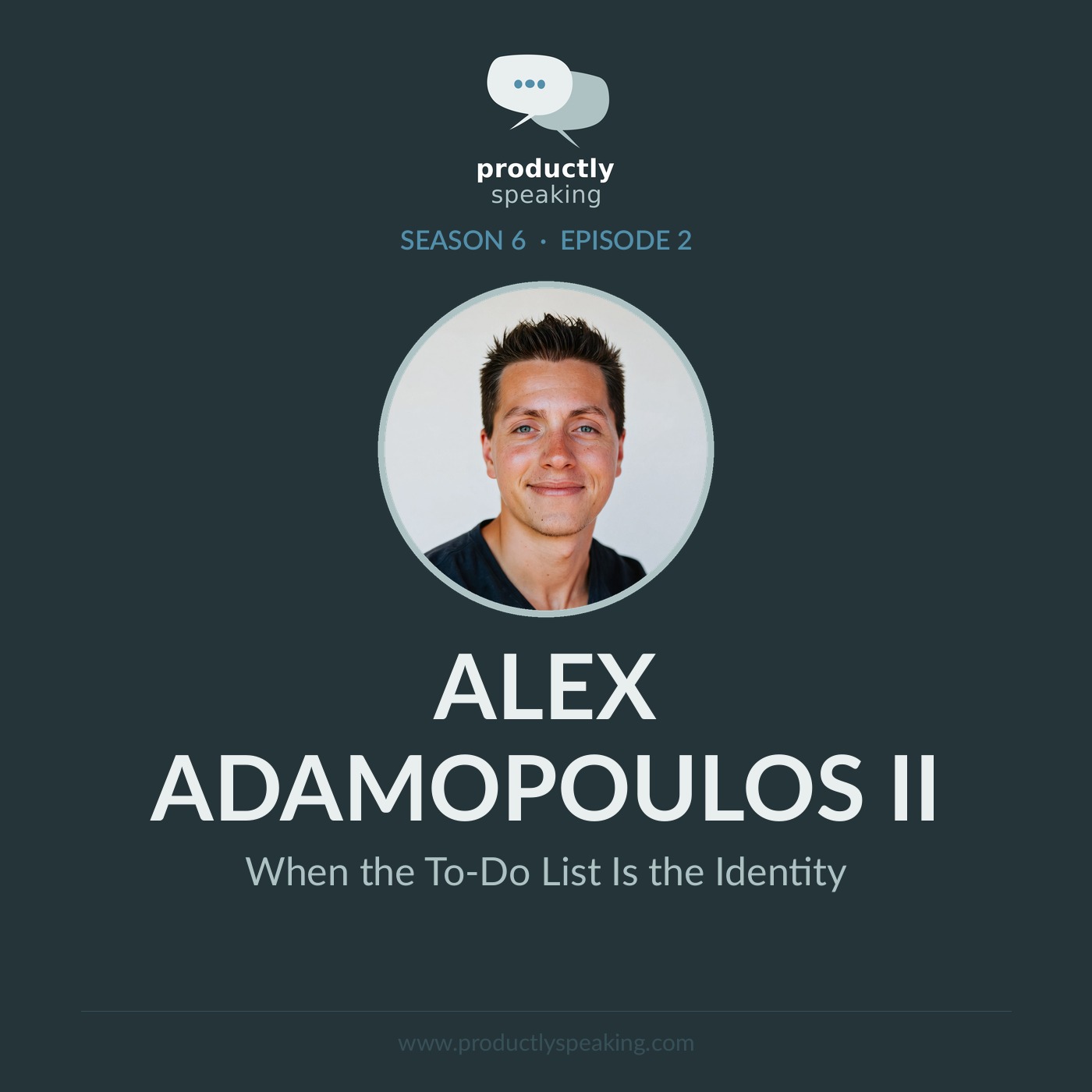
S6E2: When the To-Do List Is the Identity with Alex Adamopoulos II


 RSS Feed
 Have you ever sat through yet another transformation announcement and quietly thought, "here we go again"? Alex Adamopolous II has lived through enough of those moments to know the truth: organizations don't struggle with new processes. They struggle with the humans trying to figure them out.
In this conversation, Alex shares what 45% of workers won't tell you in surveys about burnout, the wardrobe app startup that failed because they asked all the wrong questions, and why AI is creating the pressure test that product people have been both asking for and dreading. We talk about the gap between learning something in a training room and actually applying it when the stakes are real, the discomfort of embracing ambiguity when moving from project to product thinking, and what happens when teams suddenly have time for strategic work but aren't sure they can deliver it.
This is transformation fatigue, methodology dependency, and the messy truth about change, told by someone who helps teams navigate it every day.
Guest
Alex Adamopolous II leads product development at Emerge and has spent years helping organizations navigate the human side of transformation. He specializes in work-based learning and building product capabilities in teams transitioning from project-based to product-led thinking.
Quotable Moments
"We were more obsessed with the shiny object, the idea of an app that could help people manage their wardrobe. Today, looking back, we would have killed the idea sooner if we had recognized those product management challenges more up front."
"Transformation fatigue honestly looks like exhaustion with the same initiatives or what appears to be the same initiatives being instituted by leadership over and over again."
"Just because AI can get things done at the speed of light doesn't mean that all of our human experience is immediately invalidated. We have to remain critical thinkers in the way that we use AI."
"It's now a pressure test. Are we capable of that strategic work that we always wanted more time for? And interestingly enough, I think this is an opportunity rather than a negative."
Resources
Emergn Reports and Research:
- Overcoming Transformation Fatigue (white paper by Emerge): Make overcoming transformation fatigue your unfair competitive advantage
- Global Intelligent Delusion Report (2025) - Emergn Survey Report: The Global Intelligent Delusion
Tools and Products Mentioned:
- Praxis - Work-based learning platform by Emerge featuring Stella, an AI assistant for product management work - Praxis by Emergn - Emergn
- Vibe coding tools (referenced in rapid prototyping discussion)
Key Concepts Discussed:
- Work-based learning vs. traditional training
- Five types of transformation fatigue: long wait for value, new change same as old change, methodology dependency, buzzwords that lose impact, and skills/talent retention
- Project to product transformation
- AI-assisted software development and learning
DISCLAIMER: This transcript was generated by AI and may contain errors.
Guest: Alex Adamopoulos II
Season 6 of Productly Speaking
---
[00:01] Karl Abbott:
Welcome to Productly Speaking, the podcast with real stories from real product people about the messy, surprising, and occasionally brilliant work of building things. I'm your host, Karl Abbott. Here we have no perfect processes, no polished answers, just honest conversations and lessons learned the hard way. Let's give this a go. Today on Productly Speaking, we're getting real about something most of us have lived through. That moment when your organization announces yet another transformation and everyone quietly thinks, oh no, not again. And now with AI showing up in every conversation, the pace of change isn't slowing down. It's accelerating, which means the human side of all of this, the confusion, the fatigue, the are we still doing this energy, it's more real than ever. So to help us make sense of what transformation actually feels like inside Teams, we've got Alex Adamopoulos II joining us. Alex leads product development at Emergen, and he spent years in the trenches watching how people react to change, what helps them grow, and what absolutely does not. We'll talk about learning, leadership, burnout, and yes, a little AI, but all through the lens of real humans trying to figure out how to work better together. Alex, welcome to Productly Speaking.
[01:18] Alex Adamopoulos:
Hi, Karl. Thanks for having me. It's good to be here.
[01:21] Karl Abbott:
Yeah, it's great to have you here. So before we get into the messy stuff, what's that moment that made you realize that organizations struggle way more with the human side of change than the process side?
[01:33] Alex Adamopoulos:
Throughout most of my life, I've always been a product thinker, I would call it. I've always looked at things through the lens of how they could improve. Not always trying to reinvent the wheel, but whether it was a process or an actual physical product I was using, I would always think about how could I make it better? How could it solve my problem and someone else's problem a bit more clearly? And I think organizations kind of operate in the same space when it comes to transformation. They're looking at how things operate today. They're seeing that something is fundamentally broken. They can't always articulate what it is specifically, especially if it's largely a human problem. People always gravitate towards things like process or technology being the primary challenges. But ultimately, they're really trying to fix something that already exists so they can get to the outcome they're desiring to achieve.
[02:31] Karl Abbott:
Yeah. So what's a story from early in your career when you thought, wow, we are all just trying our best in the chaos?
[02:39] Alex Adamopoulos:
Early in my career, I was involved with a startup. We were fundamentally trying to change the way people actually manage the clothes that they own. So I'm sure you kind of resonate with this a little bit. We all buy things. We have closets that we build up over time, but often there's just a few things that we wear. And the rest of it kind of sits there collecting dust. So we were looking at how we could actually help people understand what they own and make proper use of it. And then if it's something that they actually don't make use of over a period of time, how they could end up discarding that responsibly. Now, what I just articulated to you is actually a clear problem. But we didn't articulate the problem that clearly when we started. We were more obsessed with the shiny object, the idea of an app that could help people manage their wardrobe and how many recommendations they could get every day. And to be honest, the reason that startup ended up failing was because we didn't have structured product management behind it. There was no clear problem definition. There was no speaking with the customer and actually trying to understand their problems. And we felt like we were actually managing something. We were building. We were moving tasks across a board. We were trying to get people to use it and test it. But we were kind of ignoring the signals that told us things weren't working. And then ultimately, things honestly just imploded and we decided to move forward. Today, looking back, I think it would either have been very successful or we would have killed the idea sooner if we had recognized those product management challenges more up front. But again, this just didn't happen that way.
[04:31] Karl Abbott:
So was there ever a point during that time that you're like, we should bring in a product person or maybe we need to get a product opinion on this? Or was that just not even a consideration at the time?
[04:41] Alex Adamopoulos:
I think we thought we were doing product management, to be honest with you. I can say from my side, being the UX designer and the one with the product sense in that group, I definitely thought that I was doing product management. I mean, I was asking people if they liked what we were building, but that's the wrong question. So I would say to myself, I'm doing customer research. Look, I'm sitting with this person. They're testing it. They're giving me some feedback. But again, we weren't ever drilling down to the core problem. Like, for example, we jumped straight to building the app as opposed to building an Excel spreadsheet that could have done the same thing and validating whether it was even a problem. And these are all things we recognized after the fact.
[05:38] Karl Abbott:
Yeah. But as you probably know, it's the question, would you pay for this? That really gets the, do I like it or not? It's great. But if I have to pay for it, oh, hold on, hold on. That's a new question.
[05:51] Alex Adamopoulos:
It is. It is. And people, I think people probably are a little bit more flexible these days when it comes to paying for digital products only because of AI and usage-based pricing. But even still, we all want things to be free. So we could have definitely done something more lightweight. But it was our own blindness at the time that kept that from happening.
[06:16] Karl Abbott:
Yeah. So for folks who haven't lived through it yet, what does transformation fatigue actually look like on the ground?
[06:24] Alex Adamopoulos:
So what we see a lot at Emerge and what I've seen is that transformation fatigue honestly looks like exhaustion with the same initiatives or what appears to be the same initiatives being instituted by leadership over and over again. So we actually wrote a paper called Overcoming Transformation Fatigue as a company a bit over a year ago. And we talked about five types of transformation fatigue that we see. So one's called the long wait for value. So interest is waning before results arrive. And then we see new change, same as old change. So employees are looking at this new initiative and kind of have a cynical attitude towards it. This seems exactly like what we did before and doesn't really seem like anything is going to turn out differently. There's methodology dependency. So that's the one that I've personally seen the most. And I think really bugs a lot of people down. They may not recognize it as methodology dependency. You could call it process dependency. But people are too married to the way that they've been working or the one specific buzzword process like scrum that somebody taught them a long time ago and they think is the gospel. Buzzwords that lose impact is another type of fatigue. So agile transformation, people, again, become cynical towards those things. I think I can't speak for you, Karl, but even I, after a long period of time, have become a little cynical towards that term. I mean, it used to be something that people would get excited about. But now when you hear agile, you think this kind of seems like that thing that everyone said we should do, but no one actually put it into practice. And then the last one is skills and talent retention. Things seem to wane there.
[08:16] Karl Abbott:
Yeah. And when you start talking about things like agile, I've seen a number of places that have said they're agile and then pretty much are doing waterfall under the hood, but maybe reporting with the agile templates instead. So like, okay, we can play the game of mapping what we're doing into agile, but it looks like agile to the executives, but it's not actually agile on the ground.
[08:39] Alex Adamopoulos:
Exactly. Because agile is uncomfortable for people. It's fast-paced. It requires flexibility. And just innately, we don't want to be flexible as people. We work in one way. We like the way that that works. And anything contrary to that is too challenging for us to put up with.
[08:59] Karl Abbott:
Yeah. Well, I had a guest on the podcast a few seasons back who actually talked about how agile isn't a really good fit for like a big corporate organization because at that point, you've already got established products and you're not trying to build new and ramp up fast. And yet agile is very perfectly built for ramping up fast and in the startup world. So a lot of times you're talking about a bigger company who says, oh, we need to do this agile thing because everybody's doing it and it's taking off and it's the new way of engineering and it's not really a fit for every company. So yeah, you've got to be the right company to be taking that particular change. And if you don't, then yeah, you're trying to transform something in a way that it really was never meant to be transformed or it's the wrong choice. And that really drains.
[09:49] Alex Adamopoulos:
And it's interesting you phrased it that way as well because that's exactly the same thing we're seeing with AI right now, right? Every company is trying to either incorporate AI in the way they work or reorganize their business model around an AI-focused product. And while it's working for many, for many it's also not working because it's something that should have never had AI involved or maybe they're not ready for AI yet, but they're going after it just because everyone else is doing it, but they have no clear understanding of the problem it solves.
[10:26] Karl Abbott:
Yeah, that's an absolutely amazing topic to get into because AI is such a broad category. You can apply AI in so many different ways into so many different things. But again, it's kind of like your story of the startup where you've got an awesome app and you're like, look, we're making an awesome app. It's great. This is the most amazing thing. And then you don't actually solve a real problem. And so everybody's looking at you like, so? And kind of the same story with AI that there are a lot of people that have just caught this bug that, well, we've got to have AI because that's the future. That's the wave. That's where we've got to go. But nobody stops and asks, what are we actually trying to get the AI to do? And part of that is just being so early on in AI influencing our work that people don't quite know what AI is capable of just yet. And so there's a lot of discovery phase of just trying to figure out what could AI do for me? What can AI actually accomplish? And then some of that is just honest to goodness. I want to see AI everywhere. If we're not AI, we're not doing the right thing. Go make it AI, which fails.
[11:36] Alex Adamopoulos:
Exactly. It absolutely fails. And what's interesting too, right, is I think you said it, there's so many different forms of AI. It's even the way so many organizations talk about AI. Like AI is not new. It's really generative AI that has become adopted at the consumer level. That's making us think a little bit more differently about how it gets incorporated. But intelligent automation is not a new thing. I mean, we've all had AI built into our iPhones for years at this point, for much over a decade. I mean, keyboard typing prediction is machine learning.
[12:19] Karl Abbott:
License plate readers on toll roads, where you can just drive right on through and they know exactly who you are and where to send the bill to. That's all AI ML as well. These things have been done for a long time.
[12:32] Alex Adamopoulos:
And that may be enough to solve the problem for a lot of people. They don't need to go further.
[12:38] Karl Abbott:
Yeah. A lot of times you don't need a big LLM to go solve your whatever problem it is you need to apply AI to to solve. Well, sometimes an LLM is great and exactly what you want, but there's a lot of things that can be done with smaller models, which just speaks to kind of the volume of change and the volume of understanding that you have to have to really bring in, to bring something as literally, quite frankly, groundbreaking as AI ML into the way that you're doing business. And that's a big transformation. And you've seen some transformations in the past fall flat in some spectacular ways. What's one example where the intent was great, but the reality went sideways?
[13:27] Alex Adamopoulos:
So usually what we see and what I've seen, I'm not going to, of course, mention any specific customer names, but I'll talk about generally what it is that I've seen. We touched on methodology dependency a little bit earlier. And that is something I will keep going back to only because I personally think that that is the most potent problem when it comes to transformation fatigue for organizations is we have shiny object syndrome as people all the time. And we were just talking about it with AI and the same goes to how people actually work. And typically what happens is we focus on implementing that new process. I've even done this in my own teams. All right, things aren't moving the way that they should be moving. Value isn't getting delivered quickly enough. Let's redesign the entire process through how an idea goes from idea to market. We do that, but nothing changes. And why does nothing change? Because ultimately people get lost in the process. We're spending too much time looking at how does the process solve the problem rather than how do we empower people to run the process themselves so that the problem actually gets solved. So a lot of the time organizations are not emphasizing the importance of their own people being enabled to actually institute and manage change on their own. People get told what to do and told how it's going to be and their voices aren't necessarily heard, making it difficult for those changes to actually take place.
[15:07] Karl Abbott:
Yeah, and that can lead to burnout. If you're constantly in a world where you're speaking up and you're not being heard and you're carrying a lot of load, all those things can really lead into actual burnout. And how do you think that that kind of plays into transformation? What are some of the things that leaders often miss about the emotional loads that their teams are carrying?
[15:31] Alex Adamopoulos:
I mean, people feel uninformed, replaceable, and fatigued, to be honest with you. I mean, I think we've all felt that way at one period in our life. They're not trusted. They're not empowered. They're not necessarily autonomous. Now, I would say in many cases, organizations do give employees rope and they can be more proactive or more autonomous than maybe they think they can be. But oftentimes, in a large organizational setting, the hierarchical structures really do prevent people from taking that step forward to even lead from their position, whether they're a manager or not. And that kind of creates an environment where people feel like they don't have the freedom to experiment. They're burnt down. I mean, 45% of people we surveyed in our Global Intelligent Delusion report reported feeling burnt out. That's almost half of those people. And it is lower than I think has been surveyed in the past, probably because AI actually is helping people in terms of accelerating their work, maybe taking some load off. But ultimately, people aren't empowered. So burnout is going to come.
[16:46] Karl Abbott:
Yeah. And not everybody's really taken AI yet. Right now, I think we kind of have three parts of the world when it comes to AI. You've got people that haven't really touched it or staying away from it. You've got folks who have maybe used ChatGPT or one of the other tools a little bit and are kind of familiar with it. And then you've got people that have really leaned in and are really using AI to get that accelerated workflow.
[17:15] Alex Adamopoulos:
And beyond that too, there is, in terms of employees not feeling empowered, there's also organizations not investing in upskilling. That's one thing I didn't mention before I, again, went back to the AI topic. As you could tell, I like to talk about that. So later on the podcast, I'll be very talkative. But employees don't feel like they're being invested in. They feel like they're falling behind in terms of their skills.
[17:46] Karl Abbott:
Yeah. So this really lines up a lot with what you've done. You've spent years studying how people actually learn at work. What's a moment when you realized, ah, this is how real learning happens. This is what we need to be doing.
[18:01] Alex Adamopoulos:
Honestly, the advent of AI. And I'll explain that. I'll go back a little bit. So as a company, we've always advocated for work-based learning. So when we work with our customers, we structure the entire engagement around what are the actual outcomes they're trying to achieve so that when we run education in order to transform how that organization operates, there's actual real retention and real capability development. Because oftentimes, if a company brings in a vendor and they're asking them to train their people on a specific skill set, they may run a series of training courses that's disconnected from the work. So when it's time to go back and apply what they learned during that training, it's often difficult because what they learned was in a different context than where they actually work. So when we do the training, everything is tailored around the actual outcomes the customer's trying to achieve. And they're applying the learning to their work during the engagement so that they actually gain experience and develop those skills. Now, that's what we do from the consulting side. But actually, AI has made that approach to work accessible to everybody. So because we can ask an LLM any and every question, if we have a task or something we want to do or a skill we want to adopt, we don't need to go sit through a course anymore. That world has passed. Of course, courses can still be valuable. But for myself, the real moment that this hit home for me was when people started developing code through natural language prompting. Because I personally, I said it at the beginning, I've always been a product thinker. I've always had ideas. My background is in user experience design and I moved into product management. But I was never able to code. So now I'm at a place in my career where I can do two things. I can design the solution and the experience around it. And I can manage the strategy, the discovery, and I can manage the delivery of that solution. But I can't actually deliver it on my own. So when AI made it possible to actually take those ideas and bring them to life and deliver them, not only did it automate that process, but for me, I was actually able to learn and understand code more clearly. I had taken classes in the past on CSS and HTML and TypeScript. But those were things without a real use case that were never really easy for me to grasp myself. But now that I actually am taking something that I want to build and be encoding it with the assistance of AI, that's work-based learning. I'm delivering an outcome and I'm understanding what I'm doing in the process.
[20:51] Karl Abbott:
Yeah, that's a key point to actually understand what the AI has generated because it would be really easy to just let the AI do its thing and go, okay, I smoke tested it, it works. And that's not really what we ought to be doing because you still got to have the discipline of software engineering that you can completely skip over and end up in the same place that if you're using traditional methods and you skip over the traditional software engineering cycle, you're going to end up in the same place with a product that's got all sorts of issues that you don't understand. So AI just accelerates your ability to get there and it takes folks that may not have all of the specialty skills and actually empowers them to do that as well. And that is a very interesting example of learning on the job because it is a great way to then turn around and say, okay, well, I know enough about what we've done that I want to learn a little bit more about how this was structured. How does this actually do what it's supposed to do? But you've been working with learning for many years prior to AI coming on the scene and you've talked about how your company has really helped enable customers to take real learning and put that into place in their work environments. Have you seen a team go from, we don't get this for something that you're trying to come in and teach them on to, okay, we're actually doing it. And then what was that change like and what changed to make them go from that moment of we don't really understand or we're not behind what we're doing to like, oh, wow, this could work for us and now we see the path.
[22:35] Alex Adamopoulos:
So we actually have one customer right now. They're a research institute and they are focused on developing medical concepts and then working with external partners to bring those concepts to market. As a university, they can't commercialize those products on their own, but they can invest in discovering what works and what's viable and then hand that off to someone else. So they brought us in because even though they've been doing this for many years, they recognize that if they're going to keep pace with other research institutes and deliver ideas that are actually worth building, they need to learn product management. They have no idea how to structure thinking around products. They don't know how to really test and validate their ideas, especially with it being medical products that they're focused on. How do those product management concepts of experimentation and customer feedback apply there? It might be clear for some medical products more than others, but it's something that they weren't totally clear on. So they brought us in to help develop those capabilities and the way we structured it is we actually did some structured education around what is the theory of product management and I won't dive too much into the tool we built called Praxis but we built it. We have a tool that actually allows people to apply the thinking that we teach them in a more classroom setting to their actual work and then it's something we leave behind post-engagement so that they can actually keep developing their products using that tool and they've been using the tool to actually structure their ideas, design their value propositions, understand their customer problems, and then get help from our consultants as well as our AI assistant trained on our knowledge base to take those assumptions and go run experiments and it's been fascinating to see the results because they're applying it and there's less classroom time and it's very hands-on in terms of actually doing the work and then asking questions when they get stuck. They've made quite some progress and it's cool to see some of the products that they've come up with and are getting ready to hand off to a partner.
[25:02] Karl Abbott:
That is, because you're now talking about a company that's effectively making the shift from like project-based thinking into actually starting to understand how product management is different and how that can really help them up-level. So when teams make that shift from a project management approach to a product management approach, what's the part that sounds simple on paper but feels really uncomfortable in real life?
[25:31] Alex Adamopoulos:
Embracing ambiguity. So the biggest difference between project and product is that things aren't as tangible on paper. And I say that because products are effectively made up of mini projects. So we actually have a diagram that we share at Emerging that it looks like a hair comb and the frame of the comb is a product and all the little prongs within the comb for brushing your hair are projects. We talk about it that way. Project management principles are still valuable and necessary as part of product management. Somebody needs to manage a backlog. Somebody needs to make sure things are delivered and then announced to the people who need to know. But what's different is in product management, timelines are not always fixed. We communicate our desired timeline and there still should be a sense of urgency towards delivering on time. But we're driven by the customer. There's innately ambiguity there. If we're saying we're going to launch increment X in three months on this specific date, we need to be clear with leadership that this is a desired outcome. But here are the increments through which we're going to end up delivering this larger increment. And if something changes along the way, if we invalidate the idea or we discover something new or the problem isn't clearly as valuable to solve, this is not going to be delivered. And that creates a bit of uncertainty. And that's difficult for a lot of people to wade through. I mean, it's difficult for teams to wade through. Teams like to be told, here's what I'm building, here's what I'm doing. And then if something changes mid-sprint, everybody implodes. And then leadership wants something reliable that they can point to and say, this is what people are doing. Things aren't changing. And that's difficult for a lot of people to be comfortable with.
[27:29] Karl Abbott:
Yeah, so what are the human sticking points around that type of transformation?
[27:35] Alex Adamopoulos:
What do you mean exactly, the human sticking points?
[27:38] Karl Abbott:
So not necessarily the org charts and how we structure ourselves, but how people are feeling about the process along the way. What types of things are kind of holding them back potentially from helping move through that scenario?
[27:54] Alex Adamopoulos:
I'd say a lot of times people's identities are tied to what they deliver. I know I've experienced this myself. People look at what's tangible, what did I get done today, where's my to-do list, what's checked off, and then they evaluate their worth and their value either in their own career or for the organization through that lens. And when you're moving from project to product, you're not always going to have that to-do list. I mean, it's one thing to have a list that says organize, backlog, create new tickets, schedule meetings, and then you've checked all those boxes off within 90 minutes and you feel, oh, I'm productive, I got stuff done. And it's another to say, okay, I need to rethink our business model a little bit and you spend all day brainstorming, doing research, but at the end of the day, you don't have anything you can share with anybody. Now, that doesn't mean—
[29:40] Karl Abbott:
Yeah, you're a business model.
Alex Adamopoulos:
Exactly, you're not done yet. And that's okay. And people need to be okay with that because the strategic work, product work, takes a little bit more time. It's heavily thinking dependent. It's not routine. It's not repetitive. It's something that requires real human skill to work through and we need to learn to be comfortable with that, which is ironic, right? We all invest so much in developing our skills and most people in the professional world I'd like to think are ambitious and want to be successful, but as humans, we always gravitate back towards where can I just make it feel like I did the minimum and then achieve something versus being patient with the thing that takes a little bit longer but ultimately is more rewarding.
[29:40] Karl Abbott:
And now, to switch to your favorite topic, which is AI, because AI just totally, like, you talk about going from project to product. Now we've got to like go from, I've got a list of 30 tasks that I did today, see how great I am, pat me on the back, I did good, I'm a good worker, into product where, okay, now I'm delivering on longer-term outcomes. So my job is not necessarily graded on how well I did today, or what I turned in this week, but it's on longer-term outcomes. And now we throw AI into the mix, and AI can accelerate certain parts of what you're doing and can actually move you into a state of overproductivity, almost, to where the AI can move faster than the human brain can keep up with. I know I've certainly seen that in my own work, like if I kick off enough different AI things, all of a sudden, I've got AI answers for like five things, and it's like, whoa, this is going to take a lot of time to read, parse, and inwardly digest this information and actually make sense of it. This is moving really, really fast. And then it raises the question, which I think is an interesting one because it's basically the question that you have when you go from project to product, where am I in all of this? Where is my value? I don't have my 30 tasks anymore. Where am I providing value? Now with AI, oh my goodness, it just did things that used to take me hours or days to get done, and it got it done in a lot less time. I'm now sitting on all this information or sitting on this finished work product that's ready to go. Yes, I need to understand what it's done. I need to go in and make sure there's no errors because we all know that AI just says the right thing every time, right? That's a joke for anyone who hasn't worked with AI. Sometimes you have to beat it into submission to get it to go in the direction you want it to, but it really raises an honest question of where am I in this? What is my value at this point? Because if the AI was able to do all of this, where am I?
[31:48] Alex Adamopoulos:
And that's the natural question. My answer to that question would be you sit exactly where you've always sat and that's directing people towards the right outcome. And in this case, you're directing a machine towards the right outcome. I mean, just because AI can get things done at the speed of light doesn't mean that all of our human experience is immediately invalidated. I mean, AI, I think we've all seen, LLM specifically, are generalists. They have all the world's knowledge at their fingertips and they distill down into a response what they think you ask them for. Sometimes it's good, sometimes it's not. But if we quickly move towards trusting everything AI says, we will make ourselves redundant. We have to remain critical thinkers in the way that we use AI. And it can be really empowering when we look at it that way because we can say, well, AI got some of those routine tasks done and did it really well that used to take me hours and it's done, it's good, I don't need to touch it. But for the more demanding work that does take more thinking, AI can't fully replace that yet, but what it can do is it can accelerate it. It can get you started. If you need help getting started with a strategy for a greenfield product, AI can do the research, it can put together the strategy, and it can propose it to you, but it's not something you should immediately trust. But what did you just do? You saved yourself a week of research. So now you can take it, you can react to something as opposed to starting from a blank page. And I think looking at it that way, it changes the way that we use AI.
[33:32] Karl Abbott:
Yeah, really, that's excellent, excellent points because it is all about the AI can go do things, but somebody, you, as the product manager now, have to be the one to tell the AI what it's going to do and then judge, was that what I wanted it to do? Is that the right direction? Or did I learn something that now makes me rethink where I was in the first place? Because it is that human agency that now is almost even more important than before AI came along. It's really, in a lot of ways, it's raised up that product part of the equation because that becomes theoretically important and it allows us as product people to now really focus on what problem are we trying to solve in a way that we haven't necessarily had the cycles to focus on before because we're always interviewing another customer or we're always out there responding to the various number of emails that land in our box about all sorts of different topics. Product managers are stretched very thin. There is a lot of work that can be automated with AI that then removes that layer and gives you that time back. Exactly. We've spent a lot of time as product people saying, oh, if only we had more time, we could get more strategic about this. That's a very common refrain of the product person. I've said it myself plenty of times. If only I could get this tactical stuff off my plate, I'd be able to be more strategic. And now the realization is, oh, wait, if you apply AI intelligently to your work, you can get some of that tactical stuff off your plate and you can get some of that strategic thinking and that's a big idea because now it's like, okay, now I'm going to actually have to eat my words and go do that strategic work and prove that I'm worth my metal on that.
[35:30] Alex Adamopoulos:
Exactly. It's now a pressure test. Are we capable of that strategic work that we always wanted more time for? And interestingly enough, I think this is an opportunity rather than a negative. It's an opportunity for us to grow. I think less people might be capable of it than they initially thought. And we have some data to back that up. In our Global Intelligent Delusion Report, one of the measures that we found was that 55% of respondents said that their company won't meet their AI goals. In the past year, in 2025, when we did the survey and the reason was because they don't have talent that's capable of problem framing, outcome-focused design and market integration, all of the strategic things that we wanted more time for. So, the power of AI has actually exposed the skill gap and opportunities for us to really invest in developing those skills rapidly because that's a role that can only be filled by a human right now and it's something that we can step into.
[36:36] Karl Abbott:
Yeah, and that's something that Praxis is very much in the right place to help people build out because your product is all about helping people build up that product skill.
[36:47] Alex Adamopoulos:
It is indeed. We have taken all of our expertise from the last two decades and we decided that instead of exposing the world to our thinking through learning content, why not build an actual tool that structures strategic product work, not delivery work. So, we're not talking about epics and stories. We're talking about business model design, value proposition design, experimentation, and how we take a hypothesis and then go through the process of making sure we're solving the right customer problem and then if we're not, being ready to kill an idea or pivot an idea. I mean, we build Praxis to help companies kill ideas before they kill their business because so often we invest too much in just the ideas that we like because they seem like they solve a problem but we need to prove that they're actually solving a problem. So, we're using AI to help people structure their work in an actual workspace where they can also get access to expert guidance right when they need it without also needing to necessarily have a relationship with a consultant because we know AI is changing that relationship.
[38:07] Karl Abbott:
So, what's one example of AI technology actually helping a team build confidence or competence that you've seen?
[38:15] Alex Adamopoulos:
One example I can use is actually our team, the Praxis team, if that's something you want to hear about.
Karl Abbott:
Sure.
Alex Adamopoulos:
So, last year when we initially launched Praxis in April 2025, we launched it first as a learning product. So, we had been working on that for a long time, spinning up a new arm of the business and when we had launched it, the goal was always to transform it into a tool. That was the vision for the product. But at the time, we were going to start with learning because we needed to take all of our IP and get it into a format that we could deliver it to people in before then changing it to use it as training material for our AI assistant, Stella, that's built into Praxis. But when we launched the product, it was too late. 2025 was the year of AI being used to get work done and AI being used to learn. Like, as soon as we launched it, we realized, hold on a sec, this is not the product the market needs right now. So, we quickly went back to the drawing board and we were trying to think of how are we going to make this acceleration towards our vision so quickly and get the people in the team to also adapt so that they can deliver what's needed fast enough. And what we decided to do was we evaluated a set of very new vibe coding tools because that was the craze of 2025 when we decided let's take a risk and let's build a new platform, let's vibe code it, let's prototype it. And we did it. So, within two weeks, we completely reimagined the product experience all around Stella, the AI assistant. So, with the old platform, Stella was going to be a feature versus the core of the product. With the new one, Stella would be the core and everyone would have their entire work experience structured around an expert AI coach who could provide just-in-time guidance and learning while they're actually working on tasks so they could develop skills while they deliver outcomes. That was the repositioning of the product. So, we built the prototype in two weeks. Then we got it in front of over 50 customers over the course of two and a half, three months while we kept maturing the prototype. And then we ultimately won our first customer 87 days after we started building the prototype. So, in less than 90 days and getting it in front of all of those customers for feedback, we closed our first enterprise customer, which was, I mean, a huge deal. It was very fast and it was very validating because we took the principles that we teach our customers and we applied them to ourselves. We quickly recognized the challenges and the issues in our initial proposition and we're willing to kill that idea and it led to a good outcome. And now, I will preface just for anyone listening just to say that AI cannot replace software developers. We still need software developers, but we're actively using it to continue developing competencies for cross-functional teams. So, for example, in our team, we have a design engineer who has knowledge of code given her role, but we are using AI to help her morph more into an actual developer to be able to actually do logic and functional work. So, it's powerful, powerful technology.
[41:57] Karl Abbott:
Yeah, that absolutely is. That's really exciting. So, this is a lot of transformation. There's a lot of transformation going on right now. We've talked about AI transformation and then there's plenty of transformation that's happened over the last 10 to 20 years. If you could whisper one sentence into the ear of every leader kicking off a transformation, what would it be?
[42:20] Alex Adamopoulos:
Hmm, whisper one thing. I would say be clear and explicit about the problem you're solving and what great looks like and then be intentional about empowering the people in the organization to achieve that outcome themselves. So, too often, organizations end up depending on external partners throughout a transformation. Often a partner is needed because we need somebody who hasn't become jaded by being within the organization to provide a fresh perspective. But then we end up relying on them to continue solving those problems for us. But we need to empower the people in the company to do it on their own. And that's the only way we're going to see sustained change. So that's what I'd say.
[43:13] Karl Abbott:
Yeah, so what's one tiny habit our listeners can try this week that's actually going to help them move the needle on this whole transformation subject? Maybe they're stuck in a transformation that they're not really fully bought into yet, or maybe they're struggling with how AI is transforming their world, or AI hasn't really entered the space yet and they're wondering when is the AI thing coming and what does that look like? What is one thing that people can actually do to move the needle this week?
[43:41] Alex Adamopoulos:
What I would say is for anyone who feels like either they're going through a transformation where the end goal isn't explicitly clear, or they're trying to adopt AI in their workflow and they're not really sure where it fits. And lastly, if they're trying to actually incorporate AI into their actual product, to solve a customer problem, but they're not sure what problem it solves, I'd say for all three of those, spend some time and just write down the problem as you see it in one short sentence. Actually reflect on what problem is being solved. It doesn't matter what level of the organization you're at. So if you are subject to a transformation, what's your perspective on what problem this is solving? And then communicate that to your manager. Be transparent with the feedback. I'm struggling with this transformation. It seems like we're trying to solve this problem and actually have a dialogue around it and do the same for the other two scenarios I mentioned. Always be clear on the problem.
[44:51] Karl Abbott:
Yeah, so if our listeners want to find out more about you or follow you on LinkedIn, where can they do that?
[44:56] Alex Adamopoulos:
So they can definitely follow me on LinkedIn. I also am becoming an X-user, trying to share all my awesome product knowledge with everybody, so you can find me there as well. But otherwise, yeah, LinkedIn is where I'm most active.
[45:15] Karl Abbott:
Excellent. And one final question, just to help our audience get to know you a little bit better. What's one small habit or ritual that keeps you grounded when life becomes chaotic?
[45:29] Alex Adamopoulos:
One small habit or ritual. Let me see. Slow mornings. So I have an incessant desire to work. And often I wake up and I'm thinking about what I need to do today. I'm thinking about what I want to accomplish. If I make the mistake of looking at my phone and I see that something new in the technology space has been announced or there's something people are talking about, it's most likely that I will end up becoming distracted and spend time doing that. And that, honestly, creates too much stress before the day starts. And it creates an environment where I'm unfocused. Having a slow morning where I actually pretend as if technology doesn't exist and I read, I spend time with my wife, it's that that keeps me grounded before starting the workday.
[46:28] Karl Abbott:
Yeah. That's a great answer. Absolutely. Slowing down and stepping away from the computer and your phone is absolutely a good thing. Great answer. Well, thank you so much for coming on Productly Speaking.
[46:43] Alex Adamopoulos:
Of course. Thank you for having me, Karl.
[46:46] Karl Abbott:
That's Productly Speaking, brought to you by the letters P and M. If this one resonated, subscribe and pass it along. Real stories travel best by word of mouth. You can find us at www.productlyspeaking.com or on LinkedIn. I'm Karl Abbott. Thanks for listening and I'll see you in the next one.

Alex leads product development for Praxis, Emergn’s AI-driven workspace for building better products. With a background in design systems, user experience, and product strategy, Alex focuses on creating human-centered solutions that improve how teams work and deliver. He is passionate about advancing modern product practices and reimagining how organizations craft products and services that create lasting impact for their customers.


