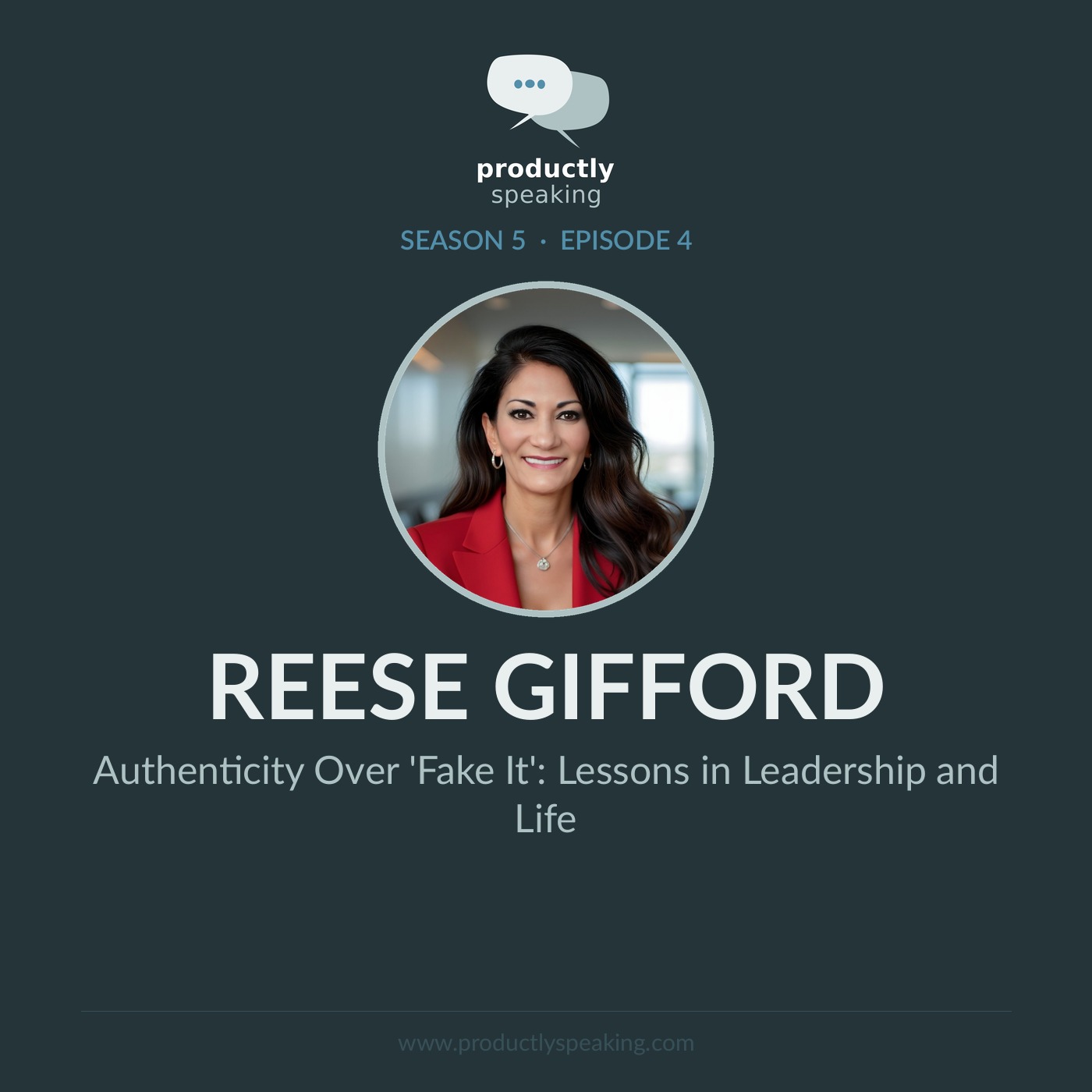
S5E4: Authenticity Over 'Fake It': Lessons in Leadership and Life with Reese Gifford


 RSS Feed
 At some point in your career, you have to decide who you’re going to be when things are uncomfortable.
In this episode of Productly Speaking, returning guest Reese Gifford joins Karl Abbott to talk about authenticity and humility, not as polished leadership traits, but as choices made under pressure. The kind that cost you something in the moment and only make sense later.
Reese reflects on entering tech in the late 90s as a young woman with no roadmap, learning early that preparation wasn’t about impressing people. It was about survival. She shares what it felt like to be underestimated in public, to carry the weight of always being “ready,” and to unlearn the belief that strength means having it all together.
They dig into the moments product leaders know well but rarely talk about. The pause before responding when someone comes at you hard. The risk of saying “I don’t know” in a room that expects certainty. The quiet judgment call between speaking up and staying silent, and how either choice will be interpreted.
This conversation isn’t about getting it right. It’s about keeping your integrity when the incentives pull you in other directions. About doing your homework, telling the truth kindly, and choosing honesty even when it complicates things.
If you’ve ever wondered whether being thoughtful is read as weakness, or whether slowing down might actually move things forward, this episode will feel uncomfortably familiar in the best possible way.
Quotable Moments
- “You’re affecting people in ways you’ll never fully understand.”
- “Being kind doesn’t mean avoiding hard conversations. It means protecting people’s dignity while having them.”
- “You don’t have to prove your worth by carrying things silently. Your voice is part of your strength.”
About the Guest
Reese Gifford is a product and technology leader with a career spanning cloud, security, open source, and global platforms. She has led work at the intersection of innovation and real-world impact, and brings a deeply human perspective shaped by decades of learning, unlearning, and showing up with care.
Resources Mentioned
- The Wandering Inn by pirateaba
- https://wanderinginn.com
- Outfox: The Becoming of Slate Stormheart by Reese Gifford and her son
- Mentioned in the episode as Reese’s debut science fiction novel co-authored with her son. Availability discussed verbally on the show.
Call to Action
If this episode felt familiar in that quiet, uncomfortable way, you’re not alone. Share it with someone who’s trying to do good work without losing themselves in the process. Subscribe wherever you listen, and pass it along the old-fashioned way. Real stories still travel best by word of mouth.
Opening
Karl Abbott:
Welcome to Productly Speaking, the podcast with real stories from real product people about the messy, surprising, and occasionally brilliant work of building things. I’m your host, Karl Abbott. No perfect processes. No polished answers. Just honest conversations and lessons learned the hard way.
Today, we’re talking about authenticity and humility. Not as leadership ideals, but as things you learn when the stakes are real. I’m really glad to welcome back returning guest Reese Gifford. Reese has spent her career navigating moments where who you are and how you show up genuinely matter. Reese, it’s great to have you back.
Reese Gifford:
Thank you so much. I’m really excited to be here.
Reese’s Background and Early Influences
Karl:
For listeners who don’t know you yet, how would you describe your journey into tech?
Reese:
I started in tech in the late 90s, so it’s been quite a journey. I’m a product and technology leader working at the intersection of innovation, security, and impact. Today my focus is secure cloud, confidential computing, and sovereignty initiatives in Asia. What’s especially meaningful right now is that it’s the first team I’ve been on in my career that’s 50 percent women. That’s been really exciting.
Karl:
You grew up in Leadville, Colorado, a mining town. How did that shape you?
Reese:
In every way. There wasn’t much status hierarchy. People worked hard, were resourceful, and relied on each other. Kindness and work ethic weren’t optional. You saw the same people everywhere, so how you treated others mattered. Those values stayed with me.
Kindness, Truth, and Responsibility at Work
Karl:
How do those early lessons show up in your work now?
Reese:
For me, kindness means telling the truth, even when it’s uncomfortable, and doing it in a way that protects people’s dignity. It’s assuming positive intent, even when things are tense. Most people aren’t trying to make your life harder. They’re doing the best they can with what they have.
Kindness also means remembering that people carry things you can’t see. A short response or missed deadline often has a story behind it. That doesn’t excuse poor behavior, but it does call for curiosity before judgment.
It’s also about accountability. If I make a mistake, I own it quickly and openly. That builds trust faster than pretending to be perfect. And doing what you said you would do is one of the most underrated forms of respect.
Choosing Kindness When It’s Hard
Karl:
Has there been a time when kindness was hard to choose?
Reese:
Absolutely. There have been moments where I made a mistake and people responded aggressively. In those situations, I’ve learned to slow down. Sometimes that means writing a response and walking away before sending it. Choosing humility and kindness in those moments helps everyone slow down, ask better questions, and resolve things collectively.
Karl:
But there’s a cost in the moment.
Reese:
There is. You’re always wondering, “If I stay quiet, am I being perceived as weak? Or thoughtful?” That’s a hard balance.
Entering Tech and Being Underestimated
Karl:
What was it like entering tech as a young woman?
Reese:
Exciting and isolating. I was often the only woman and the youngest in the room. There wasn’t a roadmap. I felt pressure to prove I belonged before I was allowed to simply contribute.
I overprepared. I learned my material deeply. I showed up grounded in substance. Being underestimated taught me to let my work speak. Over time, I stopped trying to fit into rooms and focused on what I brought into them.
There was a moment at a tech conference where a man told me he hadn’t expected me to be smart and had only approached me because I was pretty. I answered his question anyway. Those moments teach you what you’re up against.
Strength, Voice, and Vulnerability
Karl:
How did you navigate those situations?
Reese:
Very imperfectly. Early on, I thought strength meant having it all together and not showing emotion. I internalized things that weren’t mine to carry and worked harder instead.
Over time, I learned that strength includes finding your voice, asking questions, and saying when something doesn’t sit right. I also learned the importance of trusted people. People who help you understand boundaries and remind you that you’re not crazy.
I didn’t have to earn respect by tolerating things that didn’t align with my values.
Preparation, Honesty, and Trust
Karl:
You often talk about preparation. Why has it mattered so much?
Reese:
Preparation builds quiet confidence. It shows respect for people’s time. When you come prepared, you’re not reacting in the moment. You have options.
And honesty matters just as much. Pretending to know something you don’t destroys trust. Once trust is gone, it’s really hard to get back. Saying “I don’t know, but I’ll find out” is far stronger than bluffing.
I’ve made that mistake myself. Backtracking in a meeting is uncomfortable, but acknowledging it restores credibility faster than pretending.
Assuming Positive Intent
Karl:
Why does assuming positive intent matter so much to you?
Reese:
It keeps me curious instead of defensive. It doesn’t mean tolerating bad behavior. It means starting from the belief that most people want to contribute, not dominate.
That mindset changes collaboration. It leads to better outcomes. Over time, it even retrains how your brain responds to stress.
Perspective, Grounding, and Gratitude
Karl:
How do you stay grounded?
Reese:
I start every day with gratitude. Before I get out of bed, I think about my family, my health, my home. I don’t have to be perfect to be grateful.
Work matters, but it’s not everything. Family, health, integrity matter more. And when you keep that perspective, it’s easier to stay kind, honest, and human.
Karl:
Reese, thank you for coming back on the show.
Reese:
Thank you. It’s always a joy.
Disclaimer
This transcript was generated and edited with the assistance of AI and may contain errors or omissions. It is intended to improve readability and structure while preserving meaning, but it may not be a verbatim representation of the original recording.

Reese is a visionary executive who delivers the strategy and road maps that align enterprise goals, investments and capabilities with emerging market and customer needs for high-tech companies. With the proven ability to develop and communicate clear direction and goals across functions, she partners with engineering, business and external stakeholders to sustain focus and achieve milestones.


