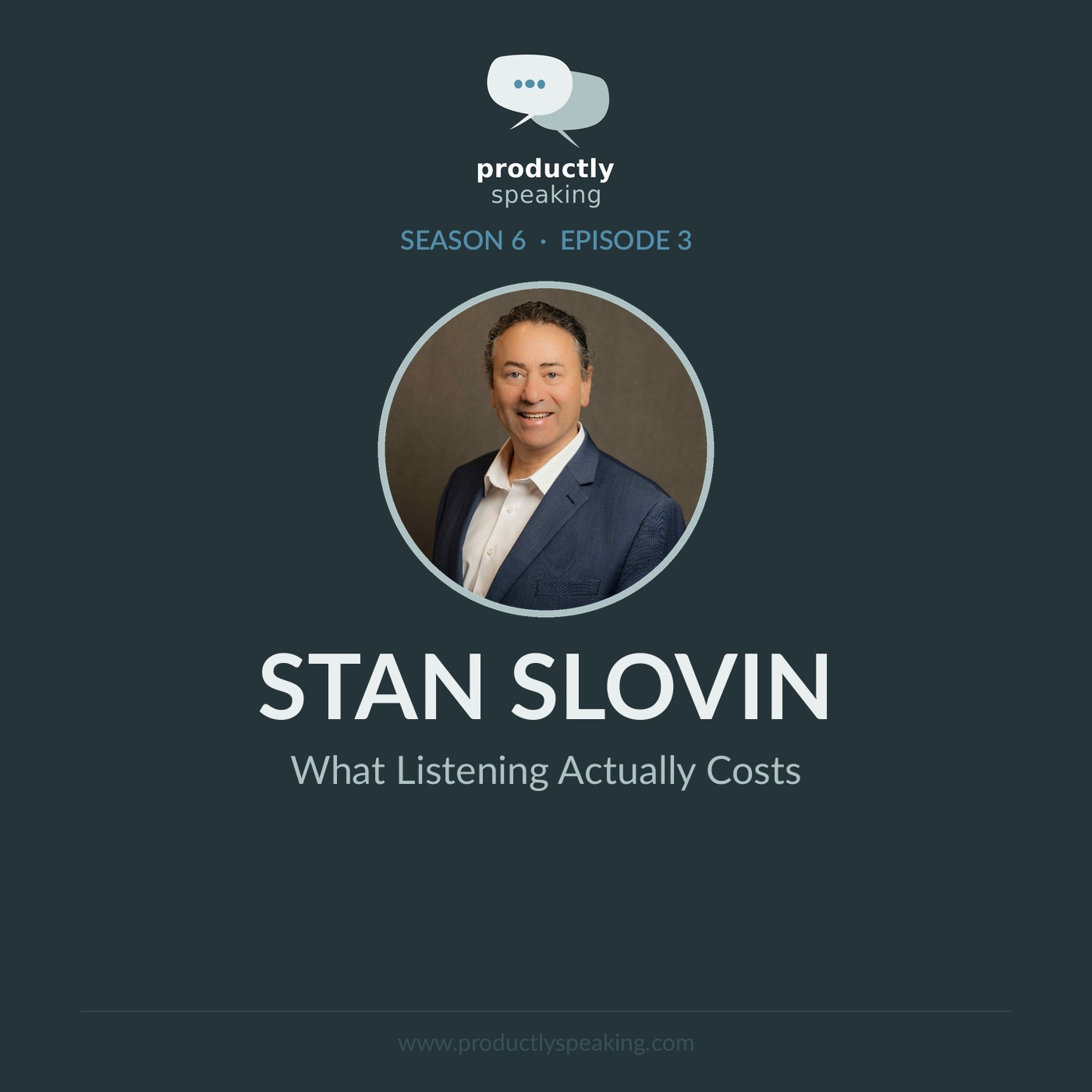
S6E3: What Listening Actually Costs with Stan Slovin


 RSS Feed
 Have you ever walked out of a meeting convinced everyone was aligned, only to discover weeks later that half the team heard something completely different? Stan Slovin has spent years working with leaders who thought they were listening, until the silence, the turnover, and the failed projects proved otherwise. In this conversation, we dig into the small tells that reveal when someone has stopped hearing you, the moment a CEO's dinner table question changed his relationship with his daughter, and why the impulse to solve instead of listen might be costing you more than you realize. This isn't about communication frameworks or active listening checklists. It's about what actually happens when people feel unheard, and the surprisingly simple shifts that turn surface interactions into conversations that build trust, clarity, and better work.
Quotable Moments:
"When you talk, you're only repeating what you already know. But when you listen, you actually may learn something."
"The number one reason clients leave is never because of performance. It's because they feel that they were not listened to."
"Listen more and say less. Because that's really where it comes down to."
About the Guest:
Stan Slovin works with leaders and teams in high-stakes environments where listening isn't optional. He's the author of a book on better listening and has seen firsthand what happens when the people doing the work feel like their voices don't matter.
Call-to-Action:
Next time someone on your team starts talking, try this: don't solve, don't respond, don't finish their sentence. Just ask them to tell you more. You might be surprised by what you've been missing. If this episode landed for you, share it with a PM who needs the reminder that listening is still the most underrated skill we have.
Resources:
- "Good to Great" by Jim Collins (referenced in the episode regarding the concept that great leaders are great listeners) - Good to Great: Why Some Companies Make the Leap...and Others Don't by Jim Collins | The StoryGraph
- "Better Listening" by Stan Slovin: https://www.betterlisteningbook.com/
**DISCLAIMER:** This transcript was generated using AI transcription and may contain errors in speaker identification, wording, or phrasing. While efforts have been made to clean and clarify the content, some inaccuracies may remain.
---
Productly Speaking - Season 6
Guest: Stan Slovin
### Topic: The Art of Total Listening in Product Management
---
[00:01] Karl Abbott:
Welcome to Productly Speaking, the podcast with real stories from real product people about the messy, surprising, and occasionally brilliant work of building things. I'm your host, Karl Abbott. Here we have no perfect processes, no polished answers, just honest conversations and lessons learned the hard way. Let's give this a go. Today on Productly Speaking, we're talking about listening, not the version we like to think we're good at, but the kind that actually shapes trust and decisions when things get messy. I'm joined by Stan Slovin, who spent years working with leaders and teams in environments where not listening came with real consequences. Stan, welcome to Productly Speaking.
[00:43] Stan Slovin:
Karl, thank you so much for having me on Productly Speaking. I'm looking forward to a fun session, engaging session, and I'm just excited to be here today.
[00:51] Karl Abbott:
Yeah, absolutely. We're glad to have you here. Tell me about a moment when you realized someone on a team wasn't truly listening and everything went off the rails. What actually happened once the misunderstanding surfaced?
[01:04] Stan Slovin:
Well, in a work environment, it's interesting. A lot of times you get into a situation where you don't really think that either people are there, you're not listening, the team's not listening, or they're not understanding. And I think it's because we're just in a world of constant disruptions. It's just nonstop notifications or, you know, very distracted by what we have in front of us, whether it's computer or texting. And what happens is that you realize they're not listening. Either one, they're distracted and you see it. Or two, you start talking more about it and you realize that what you just covered isn't being either understood or followed. And I think it creates a frustration for everyone on the team. One, it sometimes just causes a pause of time efficiency. But more importantly, it sometimes just gets into the area personally, which is like a respect factor, a consideration factor. So when we see that happen, and that happens a lot of times in teams, you got to take a pause sometimes. You have to check in. Sometimes it's even the hard question. Hey, I'm not really sure if you're kind of either understanding or hearing what we're trying to accomplish. Let me go over that again. Or can you share with me what we just talked about so that we're just all on the same page? So that's what sometimes happens when we see that at the work setting.
[02:20] Karl Abbott:
Yeah. So in those cases, who are the people that are generally feeling unheard?
[02:27] Stan Slovin:
Well, sometimes it's everyone because we're all in a kind of a response mode. I mean, today in our society, we're listening to respond versus listening to really understand. But I think really it comes back down to the leadership in the workplace. I mean, the people that are working, the employees, if they don't feel that they're being heard or their opinion is being valued or they're not being taken serious or they feel that it's just being a bullied one direction conversation. A lot of times it's the employees or the people that are working on these teams that will shut down. They'll just get quieter. They won't respond anymore. They don't feel comfortable. They don't feel confident. Sometimes they don't feel valued. That's also an issue on retention. At times, a person will be asked, why did you leave this great company or this was such a great team? And they say, you know what? I couldn't really be part of the conversation. The leadership there was one sided. They had their agenda and they really were not opening up the dialogue or the conversation for back and forth. And it was really affecting the projects. And it not only hurts them professionally, but it also hurts them in terms of the relationship working on that team.
[03:35] Karl Abbott:
Yeah, that's a really pretty heavy statement because it shows the effects of poor listening in the wild. What are some of the small tells that you notice in hindsight when that's going on?
[03:49] Stan Slovin:
It's such an interesting story. It's like the first thing you think about and this happens in both the workplace and also in relationships. A lot of times we want to put that super solver cape on and you find that actually when sometimes when you just come home and you're talking to a spouse or partner or a child and you come home and they say, hey, I had a really tough day and I want to just share with you something that's going on because I have a problem with one of my friends or this happened at work and the person starts talking and you listen for a quick second and then all of a sudden the super cape comes on. You want to solve everything. When in reality, the person just wants you to listen and sometimes they just want to vent and the person who is speaking really did not want you to solve everything in the first two seconds. Oh, you know what? I've heard this before. Let me tell you what you should do or oh, you know what? Don't worry about that. They really wanted to be heard and what happens is when they want to be heard in that situation, that scenario, I think what happens is the person sometimes is saying, hey, I just want to vent. So a great technique is this happens to all of us. We all want to solve everyone else's problems all the time. Sometimes when you're in that conversation, maybe you pause and you look at the person and says, listen, this is a really intense situation. Do you want me to just listen and kind of hear out what's going on? Or do you want me to help in terms of just share some ideas? So just checking in before you become the solver can change the whole narrative.
[05:19] Karl Abbott:
Now, that's an interesting technique, because I guess there might be times when somebody is looking to you to help solve a problem. But a lot of times they really, like you said, just want to vent.
[05:31] Stan Slovin:
Yeah, I think it comes back to the concept of just hijacking the conversations. How many times are we at dinner with friends or couples or just friends and you start talking about a place where you went to dinner or you start telling a story and the person next says, no, no, no, that's not what happened. We really were in it was a much bigger restaurant and everything. And the person looks at the person interrupting and says, OK, and they go on and they start talking. Well, it was great because when we were driving, it actually was a lot of traffic. And then the person jumps in. No, there wasn't that much traffic. And then finally, the person looks, says, do you want to tell the story? Because obviously you figured out how to interrupt me. So what happens in that, Karl? It's really crazy. But the person who is being interrupted feels disrespected. They feel embarrassed. The person that's hijacking the conversation is so used to bullying or taking over that they don't even realize they're doing it. And the people that are around the table are feeling uncomfortable. So how do you really solve that? And this happens both at work and also in social settings. Sometimes you got to take a pause. When someone's talking, we really shouldn't be looking for the flaw. And that's really one of the key things of better listening. We don't want to look for the flaw in what people are saying and jump on that. Sometimes it's letting the person finish their thoughts. And it may not be a major factor of a change or a differentiation or maybe even a misspoken thing. But it's not worth interrupting that person, making that person feel bad, embarrassing that person or worse, taking over. And finally, the person says, you know what? I'm done talking. You tell the story.
[07:05] Karl Abbott:
And that brings me to a very interesting question. Can you share a time when two people thought they were aligned, kind of like in this scenario, but were living in different interpretations of the same conversation?
[07:20] Stan Slovin:
So help me with that. When you're saying when there are two people aligned in a work setting, are you thinking in a relationship or just generally speaking?
[07:31] Karl Abbott:
Well, we could do generally speaking, but given it's a product management podcast, a work example would be interesting because this happens all the time at work where people feel like we're on the same page. We think we're aligned. But actually, we have very different views of what's going on.
[07:47] Stan Slovin:
Yes. So I think in the workplace, it's really important to, especially from the leadership standpoint, the ones that are product managers or leaders on the team or the project, they really have to start thinking about pausing before getting their agenda out. Because a lot of times we each have our own agenda and the way that we want to accomplish and directions are important and the timing is important and making sure that it's correct. All of the aspects are important, but what happens is it's a lot of talk at. So we want to change that narrative to more of a conversation where either you have both on the same team, maybe, again, saying the same thing or thinking the same thing, but they're not checking in with each other. So this gets to actually a really cool three or four step process to help those that maybe are aligned in the same way, but maybe at the same time are really missing the major definition or the importance of the conversation. So what's the first thing? First thing really that project managers and their team should do is when they're talking with each other, they should kind of first reflect to make sure that they're understanding that the responses of each other are understood. So, Karl, you and I are in a project, and we're dealing with a client. And the client has a timing and we're working on the project. And I said, well, yeah, but the specifics are not being really sent to us so that we can't really get in the movement. Instead of the person responding and saying, well, let's do it, they should stop and they should first reflect and they should say, okay, wait, when you say that the specs are not coming in, help me understand that because it sounds like we're not getting the details to move forward. So tell me a little bit more about that. That very rarely happens. We never go that next level in because we want to respond. Well, if the specs are not in, just reach out to them. Well, we don't know which specs. We don't know which details. So by reflecting to make sure that the speaker is understood, then we go to the second part and that's clarifying. Tell me a little bit more. Help me understand that more. This is a major problem potentially for the project. And then the third part, the third which is important, is empathy. Something that we don't do enough in our conversations. Product managers don't think about that on a daily basis. What kind of empathy could I instill in my communication? But think about that. If we added reflection, clarification, empathy, what we're doing is we're moving the response mode down later to the conversation. And that way we can get a better understanding of our project. I challenge all of our project managers when I talk to companies and corporations in this area. I say, how many times do you have a conversation where it goes deep in terms of understanding more than what the initial comment was? And they're like, what do you mean? Because they don't do that. But if we change the narrative and we move it to that three or four step process, then both having the same thoughts, thinking that they're on the same page, now we walk away with better clarity, better understanding, and better direction, and then better results.
[10:50] Karl Abbott:
So what is the emotional fallout when people feel unheard?
[10:55] Stan Slovin:
When people feel unheard, it is probably one of the biggest violations that is silent out there. Listening addresses so many things. But when they're not being heard, there's a cry. And that cry out is to be, one, understood. They want to empty their buckets. And they're not being allowed to. They want to share how they're feeling, not how you're feeling. They want to be in that conversation. So as a result, that person in the conversation that's being either thwarted or stopped or shortened because the person is just jumping on, finishing, whatever it is. My comment would be is pause first, clarify with that person, ask them to go deeper, let them empty their buckets. And by doing that, the listener has a better understanding to the specific topic. Because the person not being heard will get angry. They'll get resentful. They'll get hurtful. And then finally, the person will stop probably talking and probably sharing. And that does not help. We want to change the narrative to a more meaningful dialogue. That's what better listening is all about. A meaningful dialogue, an impactful discussion, a fulfilling conversation, not a surface interaction.
[12:16] Karl Abbott:
So is there any example that still sticks with you?
[12:23] Stan Slovin:
Well, every day I have examples. But so a fun one, when you write a book, it's great to get reviews. So when the one review comes and says, hey, my sales team is horrible, they're horrible listeners. I'm buying your book. That's a nice review. But that's not the fun one. The cool one is when the CEO sends me a review, flying back from a trip and says, Stan, picked up your book, fun facts, quick reminders. But that's not my review. When I got home from my business trip, I'm sitting at the dinner table with my daughter. My daughter had a bad day. She starts telling me all the things. And I'm about to solve her problems and about to start doing pontification that a parent wants to do when I stopped. And I paused. I said, you know what? It sounds like there's a lot of things going on at work and also some personal. Tell me more. She told more. She shared with him the father, not the CEO figure, but the father. And then he says, you know what? Let me ask you this. What else is going on? What else? Other than that. And she finished about 20 minutes in the dinner conversation. They finished the conversation. She got up, turned around and said, Dad, thank you for finally listening to me. That is the aha moment. It's the moment where we make those small, just small tweaks. Karl, I think we're all good listeners. I think we are. We could all be better listeners. And that changes both your professional and your personal relationship. So that's a narrative story of how that changed. Probably how we viewed not only his business approaches moving forward, but he tested it right away and changed his family picture in the most important way.
[14:16] Karl Abbott:
Yeah, that is a powerful example. Thank you for that. That's really powerful. So you've studied what you call total listening, and you're kind of hinting around that as we're talking about everybody's a good listener, but we could always be better. And you have this concept of total listening. Tell me about a moment when you saw someone do what you call total listening, and it changed the energy of a conversation.
[14:41] Stan Slovin:
I would start by quoting one of my favorite interviewers to illustrate the story. Larry King interviewed everyone in the world. I mean, he was just one of the most magnifying interviewers for decades. And he said, he always said this, he said, I remind myself every morning that nothing I say this day will teach me anything. So if I'm going to learn, I must do it by listening. And total listening is the combination of active listening. We all know what active is. Eye contact, leaning in, saying, aha, or yeah, being engaged. Where there's that active listening through the physical and the actions and the motive in the movements. Eye contact, very strong. We're having an issue today on the younger generation. They're not used to eye contact in the corporate world. Distractions, moving its distractions away and focusing and being, they call it being in the present of listening. Being in the present of listening, not just of your job, of your task, but in the presence of listening so that there's a deeper understanding. So practical part is active listening. Reflective listening, which I shared with you a little bit before, is the act of reflecting, clarifying, checking in, and then moving that response mode down. Those two elements are missing one, which brings total listening, and that's empathy. We do not use empathy enough in our communication. And that's where we're seeing the world just of very adversity, lack of understanding, not wanting to engage in deeper conversations. Empathy, which is really cool, is if you add active and reflective and you add empathy, you are showing the person, I think, that you care, that what's most important to them, how they're feeling, making sure that they know that it's okay to share and that they're not alone and that this is something that's a common thing. So by active listening and reflective listening, by putting in empathy would change the entire communication schedule and narrative to total listening. So it's those three elements that you combine together.
You were asking about an example. An example is a product manager calls for a meeting, and you see people on their text. Actually, now it's under the table and they're doing their text. They're checking in their text. You have the screens in back of you with the TVs and the eyes are wandering. People are talking and the eye contact is not there. So the product manager notices, I don't have really good active listening going on. I look at when I have my conversations and I don't hear reflection. I don't hear clarification. I just hear response, response, response. I say something, they're responding. My reflective listening part is not there. And then I'm looking around the room and I don't see anybody emptying their bucket, sharing what's most important to them, how they're feeling. Is that because I, as a leader, am not allowing for that? But here's a great question for a leader in a product manager situation. Ask your audience, ask your team, what are some ways we can improve communication and have me communicate better so that you can share more with me when we're working on projects? How many times does a product manager sit down and ask that question to their team? Very rarely because they're not thinking like that. Or a product manager can say, hey, listen, we have a lot of details. We have a lot of moving pieces. It's very important that we get this right. I want to communicate more. I want to check in more. How can I communicate with this division, with this team, with you so that as we're moving forward, I have a good idea, you have a good idea that we're both on the same page. I'd like to hear your thoughts. Tell me a little bit about how we can do that. And let them share. And when they do share, don't respond. The next question should be, so what else? Tell me more. What other things can we do? And let them be part of the solution. Let them be part, really part of that project. Get them engaged. Because great leaders, a good leader is a good listener. A great leader is a great listener. There's a great quote from the Dalai Lama. When you talk, you're only repeating what you already know. But if you listen, you actually may learn something.
[19:21] Karl Abbott:
Very similar to the Larry King quote. So what surprised you most when you began taking listening seriously?
[19:34] Stan Slovin:
What surprised me most, I think I realized myself that I was not a good listener. I think it hit me hard. I was in the industry for 15 years just going about giving advice, thinking that that's all we're supposed to do. Just tell people what they need to hear, what they need to know. And I realized one day that it was absolutely the opposite, that I really needed to find out what was most important to them, what was keeping them up at night, what they were trying to achieve. And when they shared it, not to stop and just respond so many times, but to go deeper and say, you know what, that's important. Tell me a little bit more how we can do that. Give me a couple examples of how that didn't work. And I got a deeper understanding that people wanted to be heard. Here's an interesting thing in professional services, whether it's law, financial banking, any of the professional services, the number one reason, according to Cirilli, why clients leave is never because of performance. It's because they feel that they were not listened to, that they feel that the advisors or that person did not have their best interest at heart. They didn't feel that way. Whenever I'm in a project management questioning area and they get a new client and they're in that interviewing or whatever company gets a new contract. I'm amazed that the question that does not come up in that first meeting is to the client. So tell me what's most important to you with regards to working with us or with a company like us. What's important when we do this? And the client looks at them and the client looks and says, well, what do you mean? He says, well, no, no, not us, because we want to earn this business or work with you or not who you've worked with in the past. Just generally, what is most important? And they come out and they say, you know what? Constant communication and timeliness. And what does the project manager say when they hear that? What's the first thing they say? They give a response. Oh, let me tell you how we do time. But stop. Don't respond. But hear that is the most important. You want to ask them, so tell me about that on timeliness. What does that look like to you? And once they see that they're getting the most important responses and they get them to go deeper, they can create the whole entire proposal based on that and they will close 80% more business, period. Because they focused on what's most important to the client, not what's most important to them. So that's a great takeaway question for your leadership.
[22:10] Karl Abbott:
Yeah. So can you describe a time when listening revealed something unexpected? Maybe something the other person didn't know they needed to say?
[22:21] Stan Slovin:
Yes. Three weeks ago in the car, we're coming home from a wedding and my wife says to me something and about five minutes later I responded and she looked at me and she said, wait a minute, you're not even listening to me and you wrote the book. So I'm always learning. That's a fun dynamic. You wrote the book. So I'm always learning also. I think the biggest one is on the personal side, your family, a lot of times parents or adult children or sometimes adult siblings, you'll get, you'll have a conversation and they'll look at you and say, you know what? You're just not listening. You're not getting it. You're not hearing what I'm saying. And we hear that all the time. And yet we just kind of shrug it off. But those are our most important relationships. Those are our friends. How many times are you in a group of friends? I'll tell you a story. Next time, notice when you're in a group of friends and as you're all talking, the conversation gets louder and louder and louder. You're wanting up on everybody. No one's listening to anybody. The conversation gets louder and yet we're all responding because we're competing for that time to be heard when we should be doing the opposite and we should be pausing in our group settings with our friends. And when someone says something, I'll give a great example. Vacations. Great story. You're talking to a person and they're talking to you about Barcelona. They just got back from Barcelona and they had a great trip. And you said, oh my gosh, we had a great, we did that also. We did that trip. In fact, we went to here, here, and I don't know if you went to here, but let me tell you, and they take over the vacation story when the person was just trying to share with them a great time that they just had. So a lot of times it happens in our real world settings every day. The person goes to a restaurant. I just went to this restaurant last week. It was a great Italian. Oh yeah, you know what? We tried that. That service was horrible. Well, I didn't even get a chance to say anything because I just got cut off. And that's what happens is the art of cutting off is because most people are not used to either... There's an interesting stat that you have 400 to 800 number of words per minute that the brain can process. That's it. You have about 150 words that you say before the person starts turning you off. So that's really hard. We have a hard time listening because we get distracted. Our minds are wavering. I get a question all the time from sometimes I can apply this to product managers. What happens if we can't stop the person from talking? We know that they're going to come in. It's going to be a 20 minute conversation. How do we handle with that? I want to be a better listener, but I don't have a half hour every single time this person knocks on my door. Well, that's the problem is you're not setting expectations. Person comes in the door and says, Hey, Wally, I want to talk to you about something. I found something great. You know what? That's fine. Come on in. But I only have three minutes because I'm on a call. So what can you tell me in three minutes? And the first time the person looks and says, Oh, okay. I got to get to the point because you set expectation. Sometimes the person goes on and on and you can't stop them. You have to find a pause and you have to jump in, add commonality and then deviate and move the conversation to the next point. So there's ways to slow down that one way train. We're not required to be listeners of hours and hours, but we need to be more respectful, more considerate and allow people to go deeper.
[26:00] Karl Abbott:
Yeah. So think about a high pressure moment. How did listening or the lack of it shape the outcome?
[26:09] Stan Slovin:
Well, the lack of it ends in a relationship finishing, leaving, because for whatever reason, that person did not feel that they were being heard. And that is just a taboo. Number two, when listening works, you not only hear that in a feedback mode, but you get repeat business. So if a client feels that they are respected and heard and that they are part of the conversation, they are going to bring you into the inner circle. You will build confidence. You will build trust. You will build psychological safety, which is really important, especially in our world today. So it is very important for people to have success in the narrative or the communication aspects of the relationship. So how do I see that? I see that retention is a big benefit. So retaining business shows that you were listening and that you understood the project and you understood the task, you understood the assignment. And not only did you follow it, but it was enjoyable to work with you and do it. There's a great book called Good to Great. There's a concept that there are a lot of good leaders, tons of good leaders out there, but great leaders are great listeners. There's a factor of likability. People want to work for people that listen. People want to be around people that when they feel that they're being heard, people want to stay longer when they feel that they're being respected. All of those aspects are a benefit in knowing that that's when listening was at the highest point. What's the opposite? Lower profitability, more turnover, less retention, not as many new contacts. And the feedback is when people are looking to come to the job and they're asking others, oh, you know what? That's not a great environment. No one listens over there. It's just run by one way only. And it's not a really positive environment to be around. So that's really the takeaway of why better listening is so crucial to the leaderships of these companies and product managers and owners of these companies.
[28:38] Karl Abbott:
Does that cover the question though?
[28:38] Stan Slovin:
Yeah, it's a great answer. I really enjoyed that. So that's a good answer.
[28:38] Karl Abbott:
My next question to follow up, what fears do people have that makes listening hard?
[28:55] Stan Slovin:
When you ask about fears, there's a lot of different personalities in this world. And some personalities, they're not good communicators. And as a result, it's hard. It's like my dad used to say, you can't teach an old dog new tricks, right? But the thing is, we're not dogs. We're people. And with the judgment world out there with changes with AI and technology, with the human aspect being so important today, we could all hide. I think that's one of the fears. We could hide behind the non-humanistic standpoint of the basics of listening to each other. We could hide behind text. We could hide behind AI. We could hide behind actually sharing because now we could have ChatGPT do it for us. We could hide behind shortcuts so that we don't have to spend the time to learn more or to dig deeper or to allow for a better understanding. So I think the fears out there are really created by ourselves, not necessarily only by others. And by just tweaking the way that we approach listening to others, not only will it make it better for those that are speaking to us, but then you yourself will become more confident and you'll enjoy more conversations and you'll get more benefits from it. So I think the fears out there are created both from a standpoint of personality, our social world, our area of technology. And also big one is, do I feel the environment that I'm in is allowing for open dialogue communication? I get a question all the time. I get a comment from leaders and managers sometimes that say, wait, I'm a good listener. I mean, anybody could say anything they want. I mean, come on. We have open dialogue. My door's always open. I said, really? I go, tell me the last four major, deep, meaningful conversations you've had past the surface level of a comment, a challenge and a response. I mean, just quickly share four or five with me. And they can't because they don't realize that they're not allowing for that. And that again, goes back to productivity, profit margin, retention, and better environment.
[31:22] Karl Abbott:
And you share a story where a leader misread a situation because they were listening for confirmation instead of truth.
[31:31] Stan Slovin:
A story would be where a person in charge of a project is so focused on their agenda that their feeling is that they're sharing what they want to get accomplished, what they're trying to achieve and what they want to get done is understood by everybody because there was no feedback and there was no response of not agreeing. And that's where an example would be is where the project continues. But that's because the leader or the project manager, they believe that everybody understands, is listening. And if they had a comment that they would say it. So that's a real example of where a project fails, they lose the client, they lose the assignment or future. And they find out later that the reason why is it was not really done to help. It's a great example. Construction workers building homes. Have you ever heard anyone say that building their home or major renovation went perfect? The answer is no, because construction workers, listen, they're great. They're amazing. I'm not putting them down. That industry is amazing. But they're not the best listeners. They just do what they think they're doing and they finish. And then the person walks around and says, wait, we did not want that. Or why is that over here? Or how come you did it this way? Well, that's major renovation or construction. You can't really go wrong. And yet, how many times do you hear like, oh, there were another two, three months because they had to redo this or, oh, they never came back and finished this where they're supposed to do this. Well, that's because of a lack of communication in the beginning. Someone was not listening.
Here's a great technique also. So many times when we talk and we're giving directions out, the person looks at you and says, okay, got it. And what do we think? They got it. They just said they got it. Here's a great technique. Check in with them. You know what? I'm glad you got it. And I know this is important. Just share back with me just to make sure that I'm comfortable that we're on the same page and have them come back and regurgitate what you are trying to have them accomplish. You will find that if you gave them five things to do, one of them was not clear. And you'll have to explain it again. Because we're so used to in a project saying, yeah, got it. Or, okay, no problem. Or, okay, just send me what you want. And we don't have any communication until there's a problem or confusion or when it's over and it's too late. We want to nip that earlier in the process. We want to get in with that team. And when we give assignments, we don't want the nod. There's your active listening. The nod. Thumbs up. The okay. Or the text. Got it. You want them to come back and say, okay, I'm glad you have it. This is really important. Let's just touch base to make sure that we're on the same page. Tell me again what you're going to be doing. And nine times or eight times out of ten, they'll have it. It's the two times that make the project from just being good to being complete or great.
[34:50] Karl Abbott:
So where
Let me continue with the cleaned transcript:
---
[34:50] Karl Abbott:
So where do teams struggle the most with listening?
[34:54] Stan Slovin:
Time. The time to listen. They're not, they'd rather see what's going on with the March Madness results. They want to check and see what time they got to pick up their car. They got to check and see important things when they have to check in if the kids are okay. They're distracted or they're multitasking. We're in a multitasking world. And when we're in a multitasking world, when we get a new assignment, the human element is not focused in. This is where I come back and say, it's the power of the pause. I love that. It's just the power of the pause. When you get an assignment, stop. When you give an assignment, pause. Check in. Reflect. Clarify. Add a little empathy. And then come around and then respond. Hey, can you regurgitate that? Are we good? Let's check in to make sure if there's problems. What else are you thinking? What are some of the challenges that you're going to face on this project that you might need more help on? And get them to start opening up more. Open-ended questions. Karl, oh my God, we can go back to the basics, right? Basics. It's like spring training with baseball. How many times do we go back to the basics of open-ended questions? And we are all so good, especially leaders and project managers. They're supposed to be masters of open-ended, and yet we still go back to yes and no questions. Open-ended more. Go back to the basics. How does that work? What are you facing? Why is that going to be such an issue? Where do you see? Those are the major four and five open-ended starters. And what happens is it continues to dialogue into a deeper and more meaningful conversation.
[36:42] Karl Abbott:
Yeah, so looking back, when you think about your journey in listening, what are things that you misunderstood early on that only became clear later?
[36:57] Stan Slovin:
Well, it's an ongoing journey. It's not the destination, right? It's your journey. I think, again, going back to what I shared a little bit earlier, is that just, I think from a standpoint of knowing that it's so important to people, that they really want to be heard, listened to, respected, that their comments are actually being valued, is such an art that we're starting to miss that. We're starting to see that go away. We're really seeing, again, it's listen more and say less. That's a great theme. You could put that on your whiteboard. Listen more and say less. Because that's really where it comes down to. And I think that I saw what it did that affected relationships. My daughter one day, I love this one. My daughter was talking. She's a senior in college now. But we were talking about a topic. And we're just watching something. And she started telling me the story about one of her summer jobs. And she was working on getting, and I, of course, jumped in, right, because that's what parents do. Interrupted her and told her, well, did you ever think that maybe if you, and she goes, dad, time out. I'm just telling you what happened. And she went on and started again. I wanted to share, well, maybe if you kind of get back with them and maybe ask them a couple. She goes, you know, I got to tell you, I think we're going to be done talking. Because you're not getting it. You just keep interrupting. I know you want to help me. I know you want to solve. I know you want to just talk and take over. Now, if she's feeling that, if she's feeling that, then that means that something's triggering that. It's not because she's not a great kid. It's just because she's sensing that. Well, take that to the level of your spouse, your siblings, your parents, your neighbors, your person that you work with in the church and the community, your work. If you keep interrupting people and you keep stopping them from talking, eventually they're not going to want to just talk to you anymore. And you don't want it to be too late. So I think I realized that early on. And it is just the last 10, 15, 20 years of just a different approach has made things phenomenal in both the business setting and also personal setting. Just trying to work on that.
[39:45] Karl Abbott:
So what do people tend to oversimplify about listening?
[39:50] Stan Slovin:
Oversimplifying? They think that they're great listeners. They think that they get it. They got it. Again, I'll go back to the early part of the conversation. If you ask me that question, I mean, I'll turn it around. When you say, what do I think in most simple, help me understand that. Go a little bit deeper in that one for me. What are you looking for when you say oversimplify? Because I want to make sure that I answer it correctly for you.
[40:18] Karl Abbott:
Yeah, so I guess what I'm trying to get at is, you know, people think listening is easy. They think, oh, I just need to nod my head. I just need to look at the person. And maybe there's more to it. What are the things that people miss when they think about what listening actually is?
[40:35] Stan Slovin:
Yeah, so I think what they're missing is the depth of the conversation. They're missing the opportunity to really understand what's most important. They're missing the chance to build that psychological safety, to build that trust, to build that confidence. What they're doing is they're going surface level. And surface level gets you surface results. You want deep results? You got to go deeper. And that's the part that's missing. So when people oversimplify listening, they think it's just about hearing words. But it's not about hearing words. It's about understanding meaning. It's about understanding emotion. It's about understanding what's behind what's being said. And that's where empathy comes in. That's where reflection comes in. That's where clarification comes in. So the oversimplification is thinking that if I just sit here and nod my head and say uh-huh a couple times, that I'm a good listener. That's active listening at best. But total listening requires you to go deeper. It requires you to engage. It requires you to reflect back. It requires you to clarify. It requires you to show empathy. And when you do all of that, that's when you're truly listening. And that's when you get the real benefits of listening, which is trust, which is confidence, which is better results, which is retention, which is all the things that we're looking for in our professional and personal relationships.
[41:45] Karl Abbott:
So if someone listening right now wants to improve, what's one thing they could try tomorrow in their next meeting?
[41:54] Stan Slovin:
One thing. Power of the pause. Before you respond, pause. Count to three. One, two, three. And then respond. That pause gives you time to process what was said. It gives the other person confidence that you're actually thinking about what they said. And it prevents you from just reacting. Most people, we're in reaction mode. We hear something, we immediately respond. But that pause, that three-second pause, can change everything. So tomorrow, in your next meeting, when someone says something, before you respond, pause. Count to three. And then respond. And you'll be amazed at how that simple technique changes the dynamic of your conversations. That's the power of the pause.
[42:40] Karl Abbott:
That's great advice. Stan, before we wrap up, where can people learn more about your work and your book on total listening?
[42:48] Stan Slovin:
Yeah, so the book is called "Total Listening: The Art of Hearing Between the Words" and it's available on Amazon and all major book retailers. You can also find me on LinkedIn. I'm always sharing content about listening, communication, leadership. And I do workshops and speaking engagements for companies and organizations that want to improve their listening culture. Because I truly believe that better listening leads to better results in every aspect of life, both professional and personal.
[43:18] Karl Abbott:
Fantastic. Stan, thank you so much for joining us on Productly Speaking. This has been a really enlightening conversation about something that I think we all need to work on constantly.
[43:29] Stan Slovin:
Karl, thank you so much for having me. I really enjoyed the conversation. And to everyone listening, remember: listen more, say less. And you'll be amazed at what you learn.
[43:40] Karl Abbott:
Great advice to end on. Thanks everyone for listening to Productly Speaking. Until next time, keep building, keep learning, and keep listening.

Guest Bio:
Stan Slovin is the Author of Better listening.
For over 30 years, Stanford Slovin has worked in the securities industry with individuals, families, and business owners as a financial professional with major national brokerage firms. Stan earned his bachelor of science degree in finance at the Champaign- Urbana campus of the University of Illinois. He also holds a Juris doctorate from the University of Illinois Chicago School of Law.
Stan is actively involved in charitable organizations focusing on mental health and children with disabilities. He loves traveling and plays in a rock ‘n’ roll band. Stan, his wife, and their two adult children are from the Chicagoland area


